
Differential Centrifugation Technique
The differential centrifugation technique is a widely used laboratory method in biochemistry and cell biology. It helps scientists separate cellular components based on their sedimentation rate. This method is essential for studying cell organelles such as nuclei, mitochondria, and ribosomes. Moreover, researchers use it to analyze the internal organization of cells. In addition, the technique is useful for separating non-living particles such as viruses, nanoparticles, and colloidal particles. Because of its simplicity and efficiency, it is one of the most common cell fractionation methods used in biological laboratories. You can easily download this note as a PDF using the link provided just below the post for quick access and offline reading.
Definition: Differential centrifugation technique is a laboratory method used to separate cellular organelles and particles according to their size, density, and sedimentation rate by applying increasing centrifugal forces during repeated centrifugation steps.
Differential Centrifugation Technique in Cell Biology
The differential centrifugation technique is mainly used to isolate cell organelles for biological analysis. It separates particles step-by-step using increasing centrifugal speeds.
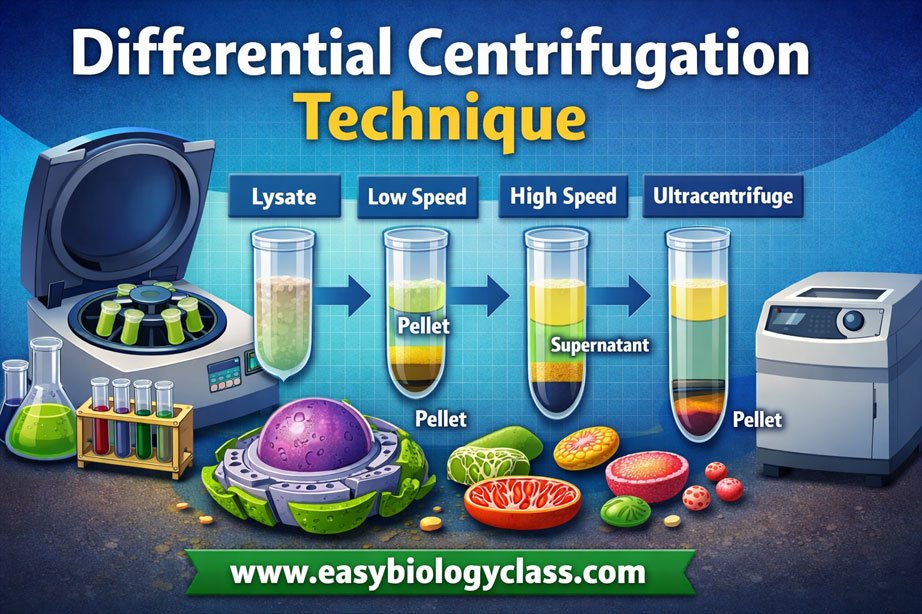
First, a tissue sample is disrupted to break the cell membrane. As a result, cellular components are released into a liquid suspension called a lysate.
Next, the lysate undergoes repeated centrifugation cycles. During each cycle:
- Larger particles settle faster and form a pellet at the bottom of the tube.
- Smaller particles remain suspended in the supernatant.
After every centrifugation step, the supernatant is transferred to a new tube and centrifuged again at a higher speed. Consequently, different organelles separate progressively.
However, this method provides only crude separation. For more precise purification, scientists often use density gradient centrifugation.
Principle of Differential Centrifugation
The separation in this technique occurs due to differences in the sedimentation rate of particles.
Several factors influence how quickly particles settle in a centrifugal field:
- Gravitational or centrifugal force
- Density difference between particle and medium
- Viscosity of the surrounding fluid
- Size and shape of particles
Larger and denser particles settle faster than smaller ones. Therefore, they form pellets at lower centrifugal speeds.
On the other hand, particles with lower density than the surrounding fluid do not sediment. Instead, they float even under strong centrifugal force. A common example is fat droplets in water.
Thus, the differential centrifugation technique separates particles mainly based on size, density, and shape.
Sedimentation Theory
Sedimentation occurs when particles move through a fluid under the influence of centrifugal force.
However, the movement of particles depends strongly on the physical properties of the system.
Key factors include:
- Fluid viscosity
- Density difference between particle and medium
- Rotational speed of the centrifuge
- Distance from the center of rotation
High centrifugal force accelerates sedimentation. Consequently, even very small particles can settle faster than the rate of Brownian motion.
In practical centrifugation systems, Stokes’ law is modified to account for changes in centrifugal force during rotation.
This theoretical understanding helps scientists determine the appropriate centrifugation speed and duration.
Procedure of Differential Centrifugation
The differential centrifugation technique follows a series of controlled centrifugation steps. Each step separates a specific cellular component.
1. Cell Lysis and Homogenization
First, cells must be broken open to release internal structures.
Gentle homogenization methods are preferred because they preserve organelle integrity. For example, a Dounce homogenizer is commonly used.
Excessive mechanical force may damage organelles. Therefore, careful homogenization is important.
The resulting mixture is known as the cell homogenate.
You may also like NOTES in... BOTANY BIOCHEMISTRY MOL. BIOLOGY ZOOLOGY MICROBIOLOGY BIOSTATISTICS ECOLOGY IMMUNOLOGY BIOTECHNOLOGY GENETICS EMBRYOLOGY PHYSIOLOGY EVOLUTION BIOPHYSICS BIOINFORMATICS
2. First Centrifugation (Low Speed)
The homogenate is centrifuged at a low speed.
Typical conditions include:
- 100 × g for 5 minutes
During this step:
Pellet contains
- Intact cells
- Large cell debris
Supernatant contains
- Cytoplasm
- Smaller organelles
3. Second Centrifugation (Medium Speed)
The supernatant from the previous step is centrifuged again at a higher speed.
Typical conditions include:
- 600 × g for 10 minutes
This step separates the nuclei from other cellular components.
Pellet contains
- Nuclei
Supernatant contains
- Cytosol
- Other organelles
4. Third Centrifugation (High Speed)
The next centrifugation step occurs at a much higher force.
Typical conditions include:
- 15,000 × g for 20 minutes
At this stage:
Pellet contains
- Mitochondria
- Chloroplasts
- Lysosomes
- Peroxisomes
Supernatant contains
- Cytosol
- Microsomes
This fraction is often called the post-mitochondrial supernatant.
5. Fourth Centrifugation (Very High Speed)
The supernatant undergoes another centrifugation at very high speeds.
Typical conditions include:
- 50,000–100,000 × g for 60 minutes
This step isolates:
Pellet contains
- Plasma membrane fragments
- Microsomal fractions
- Large polyribosomes
Supernatant contains
- Cytosol
- Ribosomal subunits
- Enzyme complexes
6. Ultracentrifugation Step
Finally, the remaining supernatant is centrifuged using an ultracentrifuge.
Typical conditions include:
- 50,000–100,000 × g for 120 minutes
This step separates very small particles.
Pellet contains
- Ribosomal subunits
- Small polyribosomes
- Some soluble enzyme complexes
Supernatant contains
- Cytosolic proteins
Advantages of Differential Centrifugation
- Simple and widely used technique
- Requires basic laboratory equipment
- Effective for separating major cell organelles
- Allows further biochemical analysis of isolated fractions
Moreover, isolated organelles often retain normal biological activity if handled carefully.
Limitations of the Technique
- Provides crude separation rather than pure fractions
- Organelles may mix between fractions
- Requires additional purification methods for precise separation
Therefore, scientists often combine it with density gradient centrifugation for improved resolution.
Conclusion
The differential centrifugation technique is a fundamental method in cell biology and biochemistry. It separates cellular components by applying increasing centrifugal forces during repeated centrifugation steps.
Because the technique relies on differences in particle size and sedimentation rate, it effectively isolates organelles such as nuclei, mitochondria, and ribosomes. Consequently, researchers can study the structure and function of cellular components in detail.
<<< Back to Biophysics Notes Page
You may also like... NOTES QUESTION BANK COMPETITIVE EXAMS. PPTs UNIVERSITY EXAMS DIFFERENCE BETWEEN.. MCQs PLUS ONE BIOLOGY NEWS & JOBS MOCK TESTS PLUS TWO BIOLOGY PRACTICAL
Study Offline!! Download this Note as a PDF
🌿 Dear Readers,
I hope you found this article helpful and easy to understand. If you have any questions, suggestions, or thoughts, I would truly love to hear from you.
Please share your feedback in the comments below. Your participation helps make EasyBiologyClass a better learning space for everyone.
Best regards,
EasyBiologyClass