
Plant Taxonomy vs Plant Systematics
A Botany Student’s Guide to Understanding the Difference
If you’re studying botany, you’ve probably seen the terms plant taxonomy and plant systematics used almost interchangeably. At first, they seem the same. But as you go deeper into plant sciences, you realize they are closely related—yet not exactly identical. Let’s break them down in a simple and practical way from a student’s perspective. You can easily download this note as a PDF using the link provided just below the post for quick access and offline reading.
Plant Taxonomy Notes | Plant Taxonomy PPTs | Plant Taxonomy MCQs
What Is Plant Taxonomy?
Origin of the Term
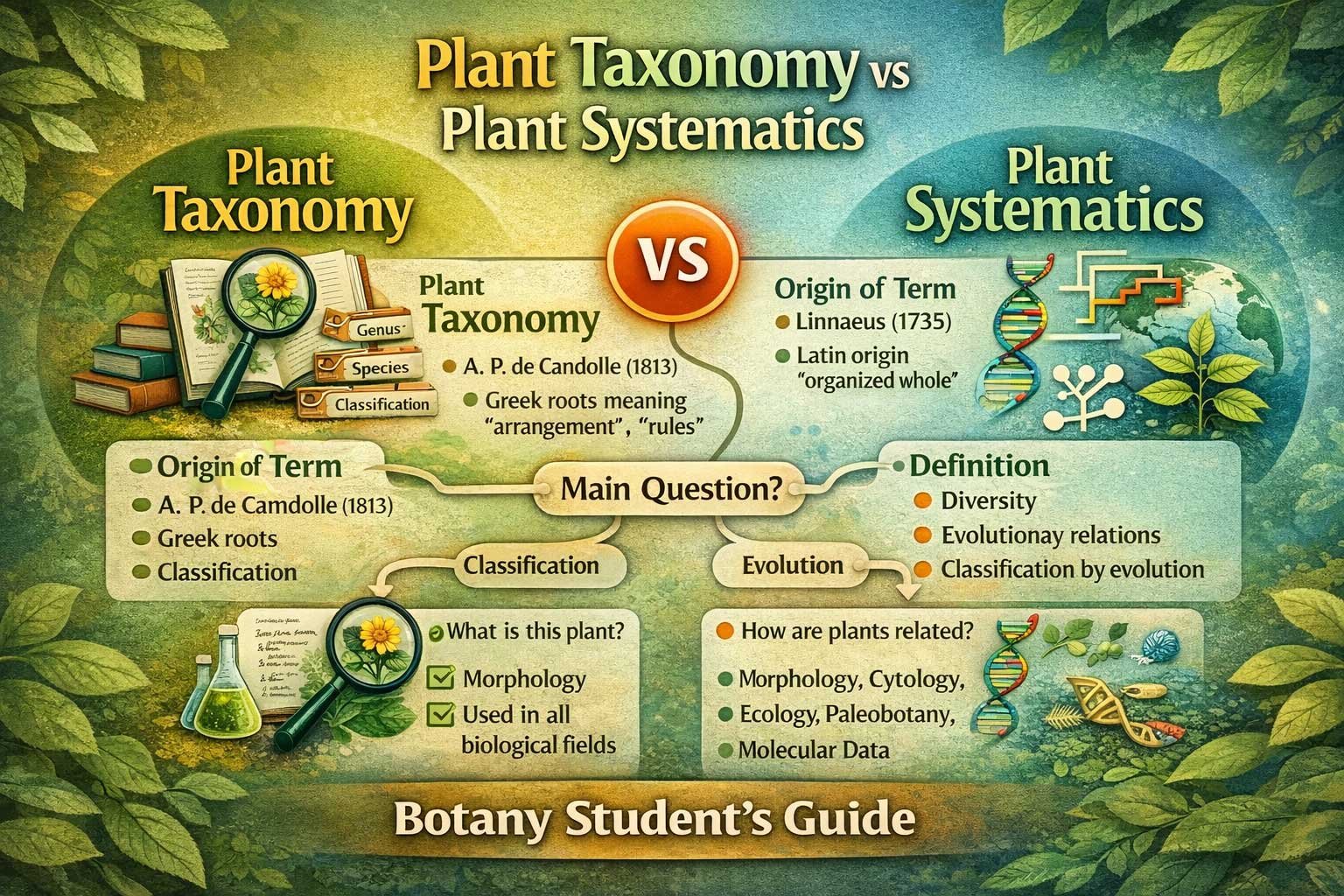
The word taxonomy comes from Greek roots meaning “arrangement” and “rules.” It was formally introduced by A. P. de Candolle in his book Theorie elementaire de la botanique.
Simple Definition
Plant taxonomy is the science of:
- Identifying plants
- Naming plants
- Classifying plants
In short, taxonomy helps us answer:
What is this plant called, and where does it belong?
Why Taxonomy Matters for Students
As botany students, taxonomy is our foundation. Before we study plant physiology, genetics, or ecology, we must correctly identify the plant we are working with. Without proper naming and classification, scientific communication becomes confusing.
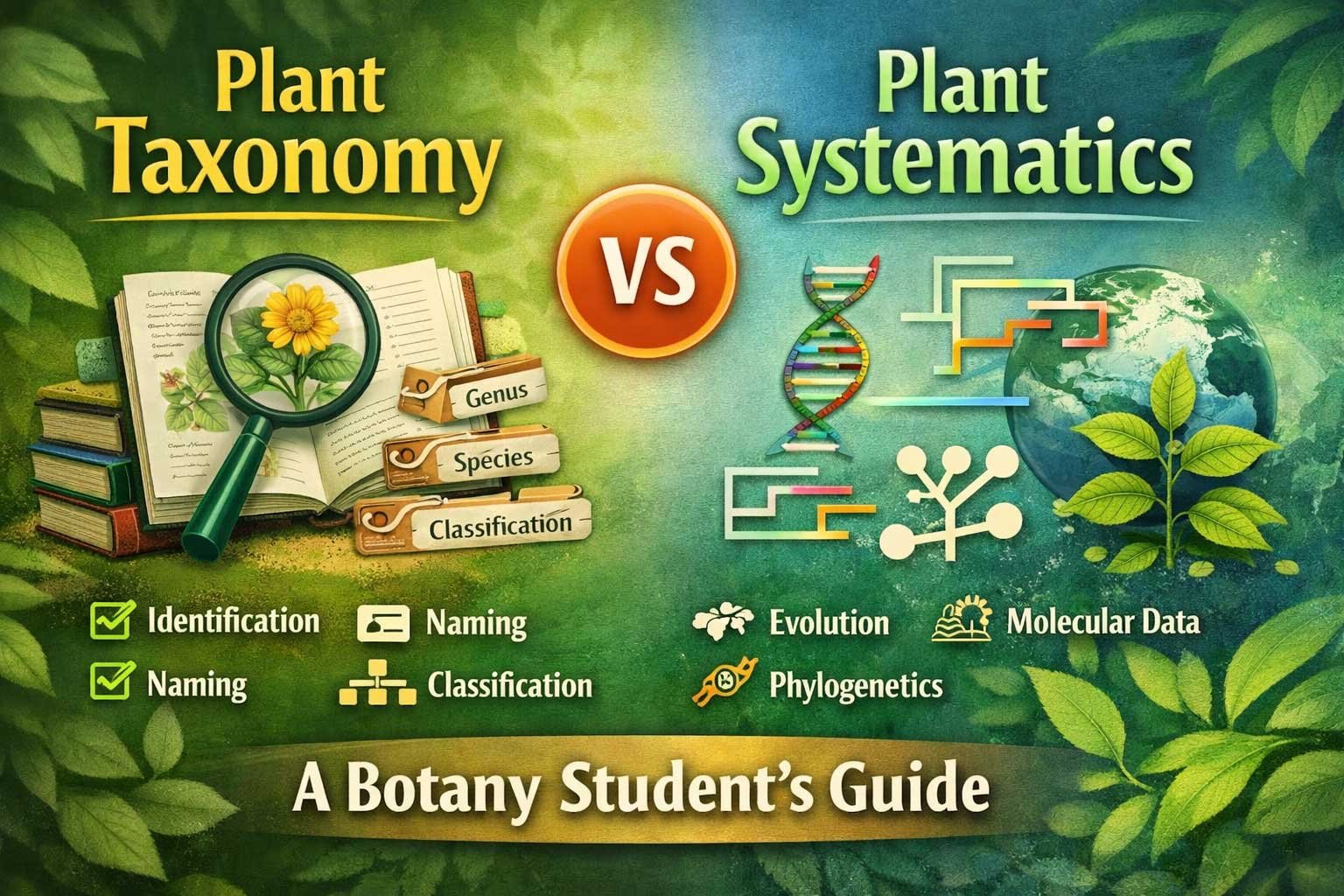
What Is Plant Systematics?
Historical Background
The term systematics comes from the Latin word meaning “organized whole.” It was used by Carl Linnaeus in works such as Systema Naturae. Later, scientists like George Gaylord Simpson defined systematics as the study of organism diversity and their relationships.
Simple Definition
Plant systematics is the broader study of:
- Plant diversity
- Evolutionary relationships
- Classification based on evolutionary history
Systematics tries to answer:
How are plants related, and how did they evolve?

Taxonomy vs Systematics: What’s the Real Difference?
1. Scope
- Taxonomy focuses mainly on naming and classifying plants.
- Systematics includes taxonomy but also studies evolution and relationships.
Think of taxonomy as a part of systematics.
You may also like NOTES in... BOTANY BIOCHEMISTRY MOL. BIOLOGY ZOOLOGY MICROBIOLOGY BIOSTATISTICS ECOLOGY IMMUNOLOGY BIOTECHNOLOGY GENETICS EMBRYOLOGY PHYSIOLOGY EVOLUTION BIOPHYSICS BIOINFORMATICS
2. Focus of Study
- Taxonomy deals with identification keys, naming rules, and classification systems.
- Systematics studies variation, evolutionary history, and lineage development.
Systematics asks deeper questions about plant ancestry.
3. Tools Used
Traditional Approach
Before Charles Darwin, plants were grouped mainly by visible similarities such as leaf shape, flower structure, and other morphological features.
Modern Approach
Today, systematics uses:
- Morphology
- Anatomy
- Cytology
- Palynology
- Ecology
- Molecular data (DNA analysis)
- Computer-based statistical methods
Modern systematics tries to reconstruct the evolutionary tree of life.
Why Are the Terms Often Used Interchangeably?
In recent decades, the meaning of taxonomy has expanded. Some scientists now define taxonomy broadly enough to include evolutionary studies. Because of this
overlap, many authors prefer using the term systematics to cover all aspects of plant classification and evolution.
However, some still consider:
- Taxonomy = narrower term
- Systematics = more inclusive term
As students, it’s important to understand both interpretations.
Why This Difference Matters to Botany Students
Understanding taxonomy and systematics is not just theoretical—it has practical value.
1. Research Work
You cannot conduct experiments unless the plant species is correctly identified.
2. Applied Sciences
Knowledge of plant relationships helps in:
- Plant breeding
- Horticulture
- Forestry
- Pharmacology
Closely related species may share useful traits, medicinal properties,
or economic importance.
3. Interdisciplinary Importance
Systematics connects with:
- Genetics
- Ecology
- Paleobotany
- Phytogeography
Without systematic knowledge, these fields lose context.
Modern View: Systematics as a Dynamic Science
Systematics is not a finished subject. It constantly changes as new data becomes available. Scientists regularly:
- Revise classification systems
- Update identification keys
- Re-evaluate evolutionary relationships
With the rapid growth of molecular biology, plant classification is continuously refined.
For students, this means:
Learning systematics is not about memorizing names—it is about understanding relationships and evolutionary patterns.
Final Thoughts: How Should Students View Them?
If you are preparing for exams:
- Remember that taxonomy deals mainly with identification and naming.
- Systematics includes taxonomy plus evolutionary study.
If you are planning research:
- Think beyond names.
- Focus on evolutionary connections and genetic relationships.
In simple words:
Taxonomy tells us what a plant is.
Systematics tells us how it is related to others and how it evolved.
Both are essential pillars of botany, and together they help us understand the incredible diversity of the plant kingdom.
Comparison Between Plant Taxonomy and Plant Systematics
| Basis of Comparison | Plant Taxonomy | Plant Systematics |
|---|---|---|
| Definition | Science of identifying, naming, and classifying plants. | Broader study of plant diversity and evolutionary relationships. |
| Main Focus | Identification and nomenclature. | Evolution, phylogeny, and relationships among plants. |
| Scope | Narrower in scope. | Wider and more comprehensive. |
| Key Question | What is this plant? | How are plants related and how did they evolve? |
| Historical Basis | Based mainly on morphological similarities. | Based on evolutionary descent and phylogenetic analysis. |
| Methods Used | Morphology, identification keys, classification rules. | Morphology, cytology, ecology, molecular data, statistical tools. |
| Relationship | Part of systematics. | Includes taxonomy within it. |
| Application | Provides correct plant names for communication. | Helps in understanding evolutionary history and applied sciences like breeding and pharmacology. |
| Modern View | Sometimes expanded to include evolutionary aspects. | Dynamic and continuously updated with new molecular data. |
You may also like... NOTES QUESTION BANK COMPETITIVE EXAMS. PPTs UNIVERSITY EXAMS DIFFERENCE BETWEEN.. MCQs PLUS ONE BIOLOGY NEWS & JOBS MOCK TESTS PLUS TWO BIOLOGY PRACTICAL
Study Offline !!! Download this Note in PDF
🌿 Dear Readers,
I hope you found this article helpful and easy to understand. If you have any questions, suggestions, or thoughts, I would truly love to hear from you.
Please share your feedback in the comments below. Your participation helps make EasyBiologyClass a better learning space for everyone.
Best regards,
EasyBiologyClass