
Maximum Likelihood Phylogeny Explained Simply with Example
Introduction
Maximum Likelihood phylogeny is a statistical method used to construct evolutionary trees from DNA data. It selects the tree that has the highest probability of producing the observed sequences under a specific evolutionary model. Therefore, it provides a strong mathematical framework for phylogenetic analysis. Today, researchers widely use this method in molecular systematics because it gives accurate and reliable results. You can easily download this note as a PDF using the link provided just below the post for quick access and offline reading.
Evolution Notes | Evolution PPTs | Systematics Notes | Systematics PPTs | Evolution MCQs
Definition
Maximum Likelihood phylogeny is a model-based statistical approach that estimates evolutionary relationships by selecting the tree that maximizes the likelihood of observing the given molecular data.
What Is Maximum Likelihood Phylogeny?
Maximum Likelihood phylogeny works on one key principle:
Choose the evolutionary tree that makes the observed DNA data most probable.
In simple words, the method asks:
If this tree were true, how likely would we observe this DNA sequence data?
The tree with the highest likelihood value is selected as the best tree.
Unlike Maximum Parsimony, which focuses on the fewest changes, this method evaluates probability using mathematical models.
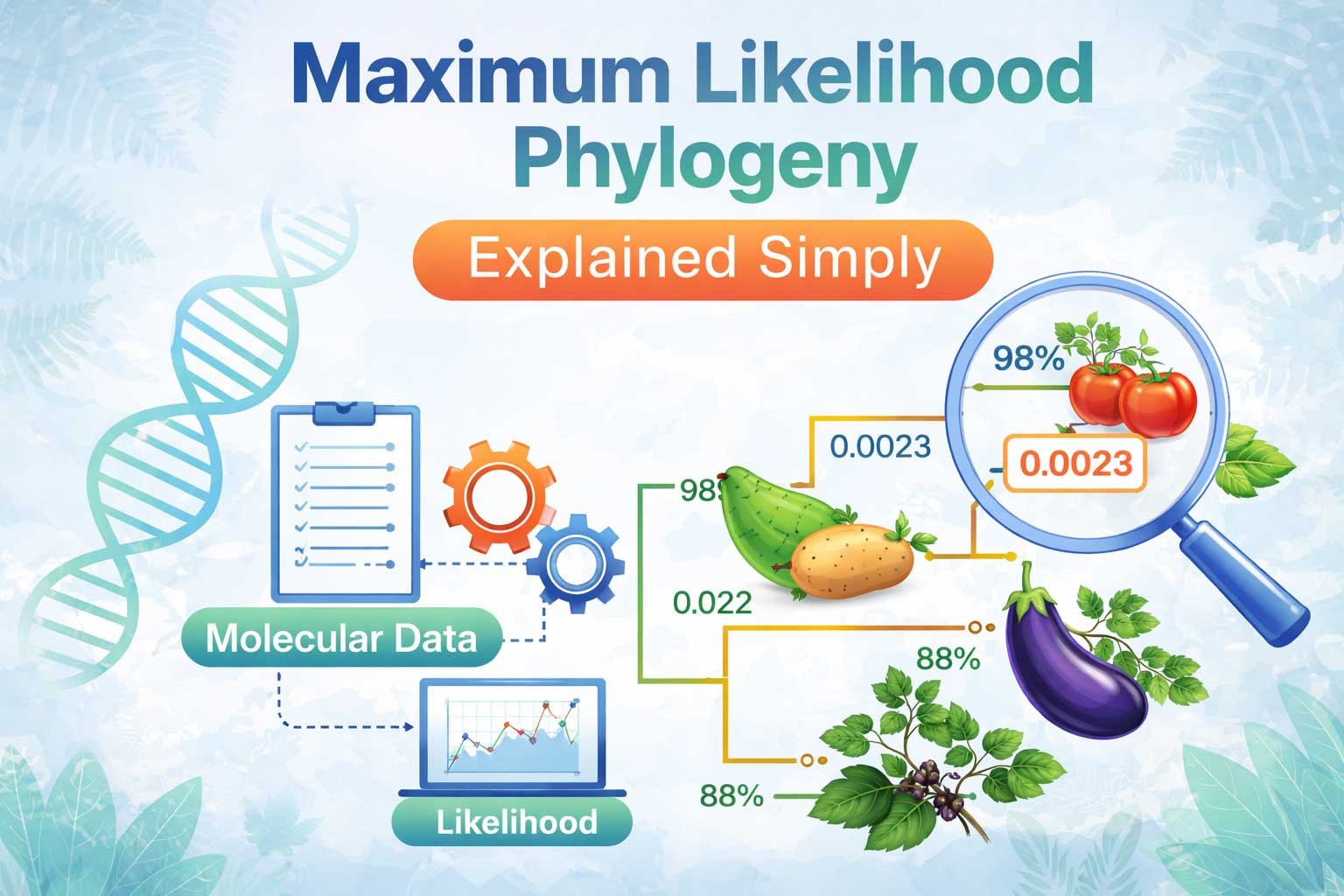
How Maximum Likelihood Phylogeny Works
The process follows several clear steps.
1. Collect Molecular Data
Researchers first obtain aligned DNA sequences. In plant studies, common genes include:
- rbcL
- matK
- ITS region
These markers provide variation needed for evolutionary comparison.
2. Select an Evolutionary Model
Next, scientists choose a substitution model. This model describes how DNA changes over time.
- Jukes–Cantor model
- Kimura 2-parameter model
- GTR (General Time Reversible) model
Choosing the correct model improves accuracy. Therefore, model testing is an important step.
3. Calculate Likelihood Values
The software evaluates many possible trees.
For each tree, it:
- Applies the evolutionary model
- Calculates the probability of the observed data
- Assigns a likelihood score
The tree with the highest score is selected.
Because the number of possible trees is very large, software tools perform complex computations.
Popular programs include:
- MEGA
- RAxML
- PhyML
These programs efficiently analyze large molecular datasets.
Interpretation of Results
Maximum Likelihood phylogeny produces:
- A best-supported tree
- Branch lengths
- Likelihood scores
- Bootstrap support values
You may also like NOTES in... BOTANY BIOCHEMISTRY MOL. BIOLOGY ZOOLOGY MICROBIOLOGY BIOSTATISTICS ECOLOGY IMMUNOLOGY BIOTECHNOLOGY GENETICS EMBRYOLOGY PHYSIOLOGY EVOLUTION BIOPHYSICS BIOINFORMATICS
Bootstrap values help measure confidence in clades.
- Above 90% → Strong support
- 70–89% → Moderate support
- Below 70% → Weak support
Thus, researchers can evaluate the reliability of evolutionary relationships.
Example from Plant Systematics
Consider a study on the genus Solanum.
- Solanum tuberosum (potato)
- Solanum melongena (brinjal)
- Solanum lycopersicum (tomato)
Researchers analyze the rbcL gene using RAxML.
The Maximum Likelihood phylogeny may show:
- Potato and tomato cluster together
- Brinjal forms a sister group
- Strong bootstrap support above 90%
Therefore, scientists conclude these species share a recent common ancestor.
This method helps taxonomists:
- Confirm evolutionary relationships
- Revise plant classifications
- Detect monophyletic groups
Comparison with Other Methods
| Method | Principle | Output |
|---|---|---|
| Maximum Parsimony | Fewest evolutionary changes | Single simplest tree |
| Bayesian Inference | Posterior probability | Set of probable trees |
| Maximum Likelihood | Highest likelihood value | Best statistical tree |
Advantages of Maximum Likelihood Phylogeny
- Statistically robust
- Uses realistic evolutionary models
- Handles complex DNA datasets
- Estimates branch lengths accurately
Limitations
- Computationally intensive
- Sensitive to model choice
- Can be slow with very large datasets
Conclusion
In summary, Maximum Likelihood phylogeny is a statistically strong method for constructing evolutionary trees. It selects the tree that best explains observed DNA data under a chosen model. As a result, it provides reliable and scientifically sound evolutionary interpretations. For students of molecular biology and plant systematics, understanding Maximum Likelihood phylogeny is essential for modern phylogenetic analysis.
<<< Back to Evolution Notes Page
You may also like... NOTES QUESTION BANK COMPETITIVE EXAMS. PPTs UNIVERSITY EXAMS DIFFERENCE BETWEEN.. MCQs PLUS ONE BIOLOGY NEWS & JOBS MOCK TESTS PLUS TWO BIOLOGY PRACTICAL
Study Offline!! Download this Notes as a PDF
🌿 Dear Readers,
I hope you found this article helpful and easy to understand. If you have any questions, suggestions, or thoughts, I would truly love to hear from you.
Please share your feedback in the comments below. Your participation helps make EasyBiologyClass a better learning space for everyone.
Best regards,
EasyBiologyClass