
Bacterial Cell Membrane: Structure and Functions
The bacterial cell membrane is an essential component of all bacterial cells. It acts as a protective boundary and controls the internal environment of the cell. Unlike eukaryotic cells, bacteria do not have membrane-bound organelles. Therefore, the membrane performs multiple vital functions. In addition, it regulates transport, produces energy, and supports cell survival. Understanding this structure is important for microbiology studies and antibiotic development. You can easily download this note as a PDF using the link provided just below the post for quick access and offline reading.
Definition: The bacterial cell membrane is a thin, flexible phospholipid bilayer that surrounds the cytoplasm. It regulates the movement of substances, supports energy production, and maintains cellular stability. This membrane is vital for bacterial survival and adaptation in different environments.
Structure of Bacterial Cell Membrane
The structure of the bacterial cell membrane is simple yet highly functional. It mainly consists of lipids and proteins arranged in a specific pattern.
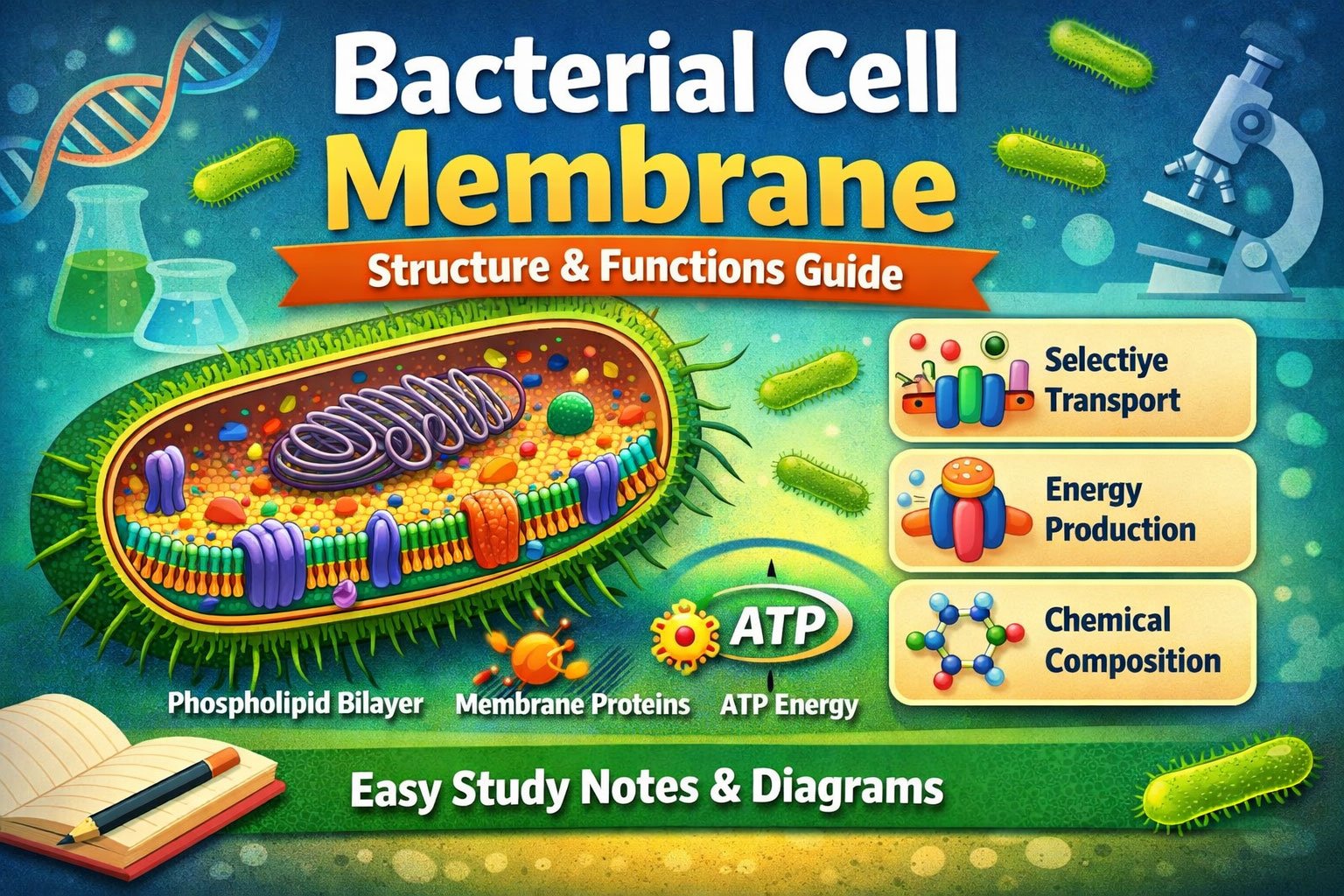
1. Phospholipid Bilayer
The membrane is formed by a double layer of phospholipids.
- Hydrophilic heads face outward toward water
- Hydrophobic tails face inward
- This arrangement creates a selective barrier
As a result, only certain molecules can pass through the membrane.
2. Membrane Proteins
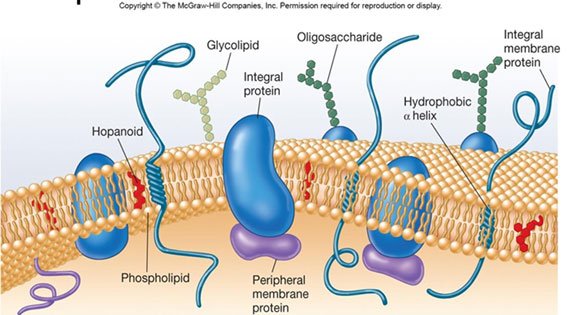
Proteins are embedded within the lipid bilayer. These include:
- Integral proteins – span across the membrane
- Peripheral proteins – attached to the surface
These proteins help in transport, enzymatic reactions, and signal detection.
3. Absence of Sterols
Most bacteria do not contain sterols like cholesterol. However:
- Some bacteria (e.g., Mycoplasma) contain sterol-like molecules
- These molecules are called hopanoids
They help maintain membrane stability and fluidity.
4. Outer Membrane in Gram-Negative Bacteria
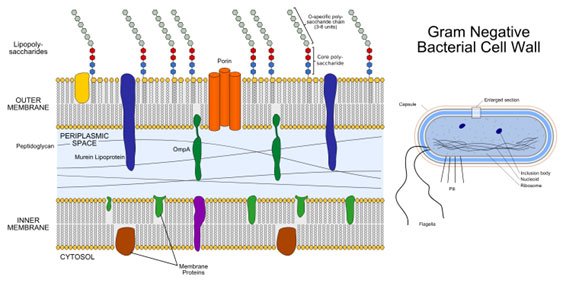
Gram-negative bacteria have an extra outer membrane.
- Contains lipopolysaccharides (LPS)
- Provides protection against harmful substances
- Acts as an additional barrier
Thus, these bacteria are often more resistant to antibiotics.
Functions of Bacterial Cell Membrane
The bacterial cell membrane performs many critical functions required for cell survival.
1. Selective Permeability
The membrane controls what enters and leaves the cell.
- Passive diffusion
- Facilitated diffusion
- Active transport
- Group translocation
Therefore, essential nutrients enter while waste products exit efficiently.
You may also like NOTES in... BOTANY BIOCHEMISTRY MOL. BIOLOGY ZOOLOGY MICROBIOLOGY BIOSTATISTICS ECOLOGY IMMUNOLOGY BIOTECHNOLOGY GENETICS EMBRYOLOGY PHYSIOLOGY EVOLUTION BIOPHYSICS BIOINFORMATICS
2. Energy Production
Unlike eukaryotes, bacteria produce energy in the membrane.
- Contains electron transport chain (ETC)
- Helps in ATP synthesis
Thus, it acts like a mitochondrial system.
3. Biosynthesis of Cell Components
The membrane supports the formation of important structures.
- Peptidoglycan (cell wall component)
- Lipopolysaccharides
- Other macromolecules
This ensures proper cell growth and repair.
4. Signal Transduction
Membrane proteins detect environmental changes.
- Receive external signals
- Trigger internal responses
As a result, bacteria adapt quickly to changing conditions.
5. Secretion of Substances
Some bacteria release enzymes and toxins through the membrane.
- Helps in nutrient breakdown
- Contributes to pathogenicity
Therefore, this function is important in infections.
6. Structural Support and Protection
The membrane provides strength and stability.
- Prevents leakage of cytoplasm
- Maintains cell shape
Hence, it plays a protective role.
Chemical Composition of Bacterial Cell Membrane
The bacterial cell membrane is chemically diverse but follows a general pattern.
1. Phospholipids
These are the main structural components.
- Amphipathic molecules
- Form the bilayer structure
2. Proteins
Proteins form a large portion of the membrane.
- Transport proteins
- Enzymes
- Structural proteins
3. Hopanoids
Hopanoids are present in some bacteria.
- Similar to sterols
- Maintain membrane rigidity
4. Lipopolysaccharides (LPS)
Found in Gram-negative bacteria only.
- Provide protection
- Act as endotoxins
5. Peptidoglycan Precursors
Precursors for cell wall synthesis are present in the membrane.
- Help in building the cell wall
- Support growth and division
6. Ion Channels and Transporters
These are protein complexes.
- Allow movement of ions
- Maintain internal balance
Mesosomes in Bacteria
Structure and Types of Mesosomes
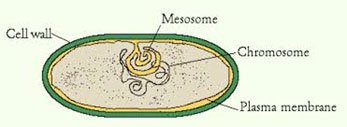
Mesosomes appear as folds of the plasma membrane. They are classified into:
- Septal mesosomes – linked with cell division
- Lateral mesosomes – located away from division sites
Proposed Functions of Mesosomes
- DNA replication and separation
- ATP production
- Enzyme secretion
- Cell wall formation
Modern View on Mesosomes
Recent research has changed our understanding.
- Mesosomes are likely artifacts
- Formed during chemical fixation in microscopy
- Not present in living cells
Conclusion
The bacterial cell membrane is a vital structure that supports survival, growth, and adaptation. It controls transport, produces energy, and protects the cell. In addition, its unique composition makes it an important target for antibiotics. Understanding the bacterial cell membrane helps students grasp key microbiology concepts effectively.
FAQs
1. What is the bacterial cell membrane?
The bacterial cell membrane is a thin, flexible layer that surrounds the cytoplasm. It controls the movement of substances in and out of the cell. In addition, it helps in energy production and maintains cellular stability.
2. What is the structure of the bacterial cell membrane?
The structure of the bacterial cell membrane consists of a phospholipid bilayer with embedded proteins. The hydrophilic heads face outward, while hydrophobic tails face inward. This arrangement creates a selectively permeable barrier.
3. What are the main functions of the bacterial cell membrane?
The bacterial cell membrane performs several important functions, including:
- Regulating transport of substances
- Producing ATP through respiration
- Supporting biosynthesis of cell components
- Providing structural protection
4. What is the chemical composition of the bacterial cell membrane?
The bacterial cell membrane mainly contains:
- Phospholipids
- Proteins
- Hopanoids (in some bacteria)
- Lipopolysaccharides (in Gram-negative bacteria)
5. Are mesosomes real structures in bacteria?
Mesosomes were once thought to be part of the bacterial cell membrane. However, modern studies show they are likely artifacts formed during sample preparation. Therefore, they are not considered real structures in living bacterial cells.
<<< Back to Microbiology Notes Page
You may also like... NOTES QUESTION BANK COMPETITIVE EXAMS. PPTs UNIVERSITY EXAMS DIFFERENCE BETWEEN.. MCQs PLUS ONE BIOLOGY NEWS & JOBS MOCK TESTS PLUS TWO BIOLOGY PRACTICAL
Study Offline!! Download this Note as a PDF
🌿 Dear Readers,
I hope you found this article helpful and easy to understand. If you have any questions, suggestions, or thoughts, I would truly love to hear from you.
Please share your feedback in the comments below. Your participation helps make EasyBiologyClass a better learning space for everyone.
Best regards,
EasyBiologyClass