
Aims of Systematics: 8 Key Objectives Explained
The aims of systematics are essential for understanding modern biology. Systematics helps scientists classify organisms and study their evolutionary relationships. Moreover, it organizes biodiversity using scientific evidence. Therefore, biology students must clearly understand this topic for academic and competitive examinations. Systematics connects taxonomy with evolution. As a result, it makes biological classification logical and evidence-based. You can easily download this note as a PDF using the link provided just below the post for quick access and offline reading.
Definition of Aims of Systematics
Aims of systematics refer to the major objectives of studying classification, identification, and evolutionary relationships of organisms. These aims help organize biodiversity, reconstruct phylogeny, integrate biological data, and develop natural classification systems based on scientific evidence.
What Are the Aims of Systematics?
The aims of systematics focus on studying biological diversity and evolutionary history. In addition, they ensure correct naming and classification of organisms.
Modern systematics uses:
- Morphological characters
- Molecular evidence
- Genetic data
- Bioinformatics tools
Thus, classification reflects true evolutionary relationships.
8 Major Aims of Systematics
1. Convenient Identification and Scientific Communication
One of the primary aims is accurate identification.
- Provides universal scientific names
- Reduces confusion from local names
- Supports global scientific communication
Therefore, researchers worldwide can exchange information clearly.
2. Inventory of Global Biodiversity
Another important objective is documentation of species.
- Records plant and animal diversity
- Describes newly discovered species
- Maintains biodiversity databases
This inventory supports conservation programs.
You may also like NOTES in... BOTANY BIOCHEMISTRY MOL. BIOLOGY ZOOLOGY MICROBIOLOGY BIOSTATISTICS ECOLOGY IMMUNOLOGY BIOTECHNOLOGY GENETICS EMBRYOLOGY PHYSIOLOGY EVOLUTION BIOPHYSICS BIOINFORMATICS
3. Reconstruction of Evolutionary History
The aims of systematics include tracing phylogeny.
- Studies ancestral relationships
- Analyzes morphological and molecular traits
- Explains species divergence
As a result, scientists understand how life evolved over time.
4. Development of Natural Classification Systems
Modern classification reflects common ancestry.
- Groups organisms based on evolution
- Uses phylogenetic trees and cladograms
- Avoids artificial grouping
Thus, classification becomes more scientific and natural.
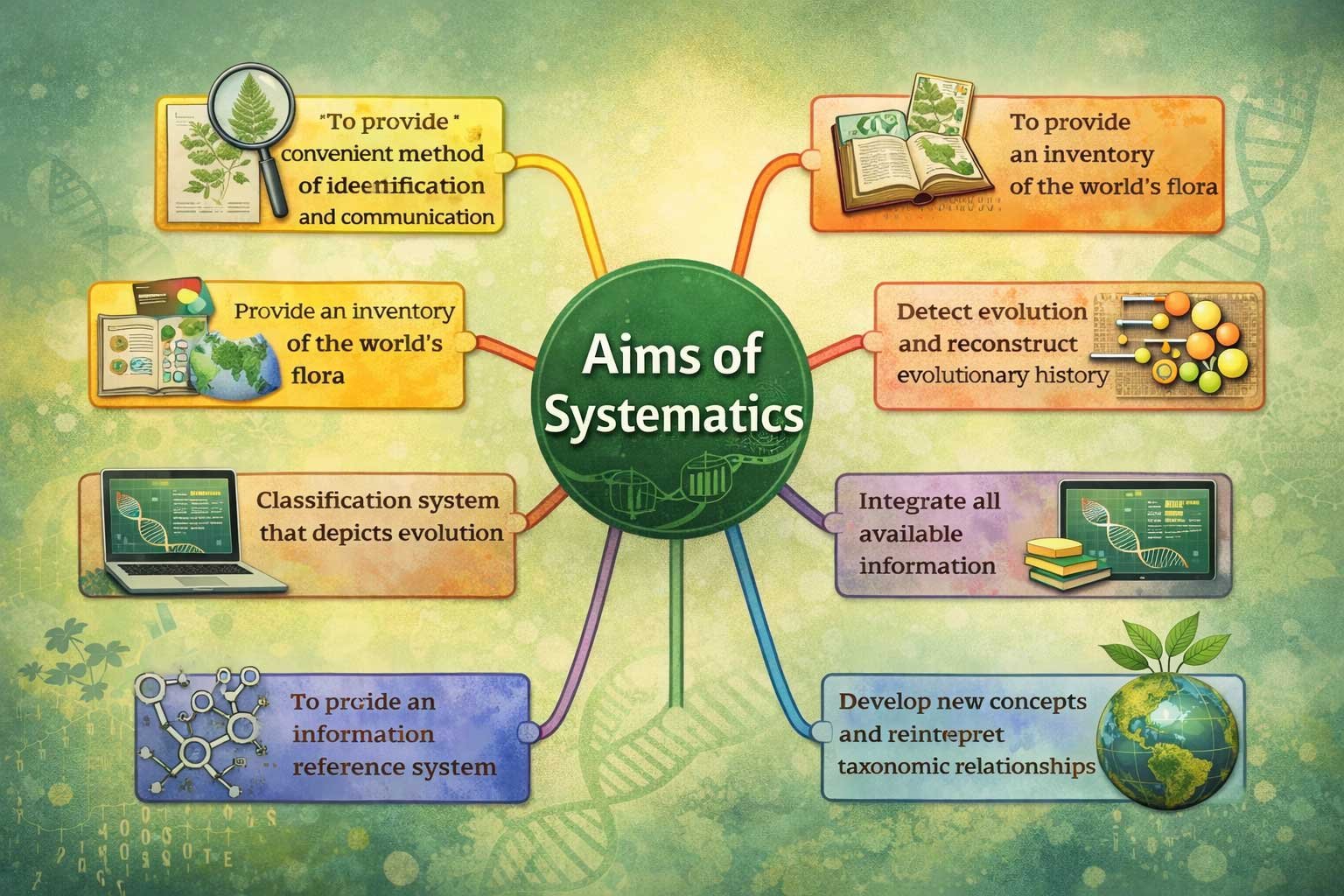
5. Integration of Biological Information
Systematics combines data from various biological fields.
- Morphology and anatomy
- Genetics and molecular biology
- Computational analysis
Therefore, classification accuracy improves significantly.
6. Creation of Reference Systems
Another key aim is developing structured information systems.
- Maintains herbarium records
- Preserves museum specimens
- Stores taxonomic descriptions
Hence, systematics acts as a scientific reference tool.
7. Development of New Taxonomic Concepts
Scientific knowledge changes continuously. Consequently, systematics updates classification.
- Refines species concepts
- Introduces new principles
- Adopts advanced research findings
This ensures classification remains modern.
8. Reinterpretation of Taxonomic Relationships
With new discoveries, relationships may change.
- Revises earlier classifications
- Incorporates molecular phylogeny
- Corrects identification errors
Thus, the aims of systematics support dynamic scientific progress.
Importance of Aims of Systematics in Modern Biology
The aims of systematics are highly significant in applied sciences.
- Support biodiversity conservation
- Assist agriculture and medicine
- Strengthen ecological research
- Improve exam preparation for students
Moreover, systematics builds a strong foundation for evolutionary biology.
MCQs on Aims of Systematics
1. Which of the following is a primary aim of systematics?
A. Studying cell metabolism
B. Organizing biodiversity scientifically
C. Measuring population density
D. Studying chemical reactions
Answer: B. Organizing biodiversity scientifically
2. The reconstruction of evolutionary history is known as:
A. Ecology
B. Cytology
C. Phylogeny
D. Physiology
Answer: C. Phylogeny
3. Which type of data is commonly used in modern systematics?
A. Only morphological data
B. Only molecular data
C. Morphological and molecular data
D. Economic data
Answer: C. Morphological and molecular data
4. Why does systematics provide universal scientific names?
A. To increase species number
B. To reduce confusion in communication
C. To simplify experiments
D. To shorten classification
Answer: B. To reduce confusion in communication
5. Which tool is used to show evolutionary relationships?
A. Histogram
B. Pie chart
C. Cladogram
D. Bar graph
Answer: C. Cladogram
6. One important aim of systematics is:
A. Increasing mutation rate
B. Developing artificial classification
C. Integrating biological information
D. Limiting species discovery
Answer: C. Integrating biological information
7. Updating classification based on new evidence reflects:
A. Static taxonomy
B. Dynamic systematics
C. Artificial grouping
D. Random classification
Answer: B. Dynamic systematics
8. The aims of systematics are important for:
A. Medicine and agriculture
B. Biodiversity conservation
C. Evolutionary studies
D. All of the above
Answer: D. All of the above
FAQs on Aims of Systematics
1. What are the aims of systematics?
The aims of systematics include organizing biodiversity, identifying organisms, reconstructing evolutionary history, integrating biological data, and developing natural classification systems based on scientific evidence.
2. Why are the aims of systematics important for students?
They help students understand classification, phylogeny, and evolutionary biology clearly. Moreover, this topic is frequently asked in academic and competitive examinations.
3. How does systematics differ from taxonomy?
Taxonomy mainly focuses on naming and classification. However, systematics studies evolutionary relationships in addition to classification. Therefore, systematics is broader than taxonomy.
4. How does modern systematics study evolutionary relationships?
Modern systematics uses morphological traits, molecular data, genetic evidence, and computational tools. As a result, classification reflects true evolutionary history.
5. How do the aims of systematics support biodiversity conservation?
Systematics prepares species inventories and identifies relationships among organisms. Consequently, it helps scientists design effective conservation strategies.
Conclusion
In conclusion, the aims of systematics go far beyond simple classification. They organize biodiversity, reconstruct evolutionary history, integrate biological data, and develop natural classification systems. Therefore, understanding the aims of systematics is essential for biology students and competitive exam preparation.
<<< Back to Plant Systematics Notes Page
You may also like... NOTES QUESTION BANK COMPETITIVE EXAMS. PPTs UNIVERSITY EXAMS DIFFERENCE BETWEEN.. MCQs PLUS ONE BIOLOGY NEWS & JOBS MOCK TESTS PLUS TWO BIOLOGY PRACTICAL
Study Offline!! Download this Note as PDF
🌿 Dear Readers,
I hope you found this article helpful and easy to understand. If you have any questions, suggestions, or thoughts, I would truly love to hear from you.
Please share your feedback in the comments below. Your participation helps make EasyBiologyClass a better learning space for everyone.
Best regards,
EasyBiologyClass