
AI in Genomics: Simple Student Guide
Introduction
Modern genome sequencing technologies have changed biological research dramatically. Scientists can now sequence entire genomes within a short time. As a result, laboratories generate massive volumes of genetic data every day. However, analyzing this data is not easy. Traditional computational tools often struggle to manage large and complex genomic datasets. Therefore, researchers increasingly depend on AI in genomics to process and interpret biological information.
Artificial intelligence can recognize patterns, analyze huge datasets, and detect hidden biological relationships. Because of these abilities, AI is now widely used in structural genomics and functional genomics. These fields help scientists understand genome structure and gene function more clearly.You can easily download this note as a PDF using the link provided just below the post for quick access and offline reading.
Definition of AI in GenomicsAI in genomics refers to the use of artificial intelligence technologies to analyze genomic data and biological systems. These systems apply machine learning and deep learning algorithms to study DNA sequences, predict protein structures, interpret genetic variants, and understand gene functions.
Role of AI in Genomics Research
The importance of AI in genomics continues to grow in modern life sciences. Researchers must analyze enormous genomic datasets produced by sequencing technologies. Therefore, AI helps manage this complexity.
Artificial intelligence improves genomic research in several ways:
- Faster data analysis
- Accurate gene prediction
- Discovery of biological patterns
- Better understanding of genetic diseases
Consequently, AI has become an essential tool in genomics and bioinformatics.
Understanding Structural and Functional Genomics
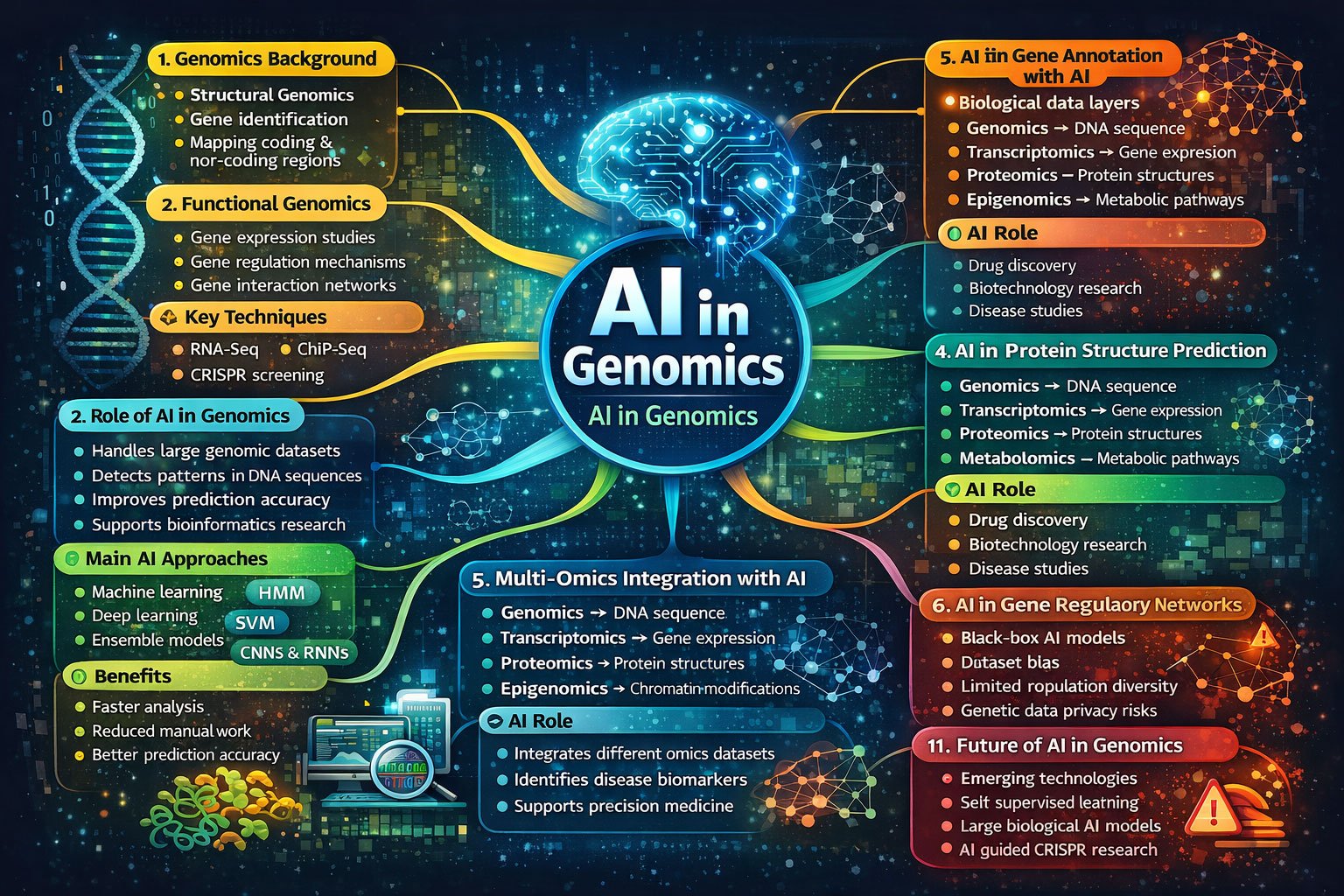
Structural genomics and functional genomics represent two major branches of genomic research. Although they study the genome differently, both fields benefit greatly from AI in genomics.
Structural Genomics
Structural genomics focuses on the physical organization of genomes. Scientists study DNA sequences to identify genes and genomic regions.
Key activities include:
- DNA sequencing
- Gene identification
- Mapping coding and non-coding regions
The main objective is to create a complete genomic map of an organism.
You may also like NOTES in... BOTANY BIOCHEMISTRY MOL. BIOLOGY ZOOLOGY MICROBIOLOGY BIOSTATISTICS ECOLOGY IMMUNOLOGY BIOTECHNOLOGY GENETICS EMBRYOLOGY PHYSIOLOGY EVOLUTION BIOPHYSICS BIOINFORMATICS
Functional Genomics
Functional genomics examines how genes function within cells. It studies gene expression, regulation, and interactions.
Common techniques include:
- RNA sequencing (RNA-Seq) for gene expression analysis
- ChIP-Seq for studying protein–DNA interactions
- CRISPR screening for identifying gene functions
Together, these approaches explain how genes control biological processes.
AI in Genome Annotation and Assembly
Genome annotation involves identifying important features within DNA sequences. These features include genes, promoters, enhancers, and regulatory elements.
Previously, genome annotation required extensive manual work. However, AI in genomics has significantly improved this process.
Machine learning algorithms now analyze DNA sequences efficiently. Important computational models include:
- Hidden Markov Models (HMMs)
- Support Vector Machines (SVMs)
- Ensemble learning methods
In addition, deep learning approaches such as convolutional neural networks (CNNs) and recurrent neural networks (RNNs) detect complex regulatory patterns in DNA.
Highlight
AI-based genome annotation tools reduce analysis time and improve gene prediction accuracy. This is especially useful for newly sequenced organisms.
AI in Protein Structure Prediction
Proteins perform many essential biological functions inside cells. Their activity depends strongly on their three-dimensional structure.
Predicting protein structure from amino acid sequences has been a long-standing challenge. However, recent progress in AI in genomics has improved this task significantly.
Deep learning models analyze sequence patterns and evolutionary relationships. As a result, they can predict how proteins fold into functional structures.
These models can also identify:
- Protein–protein interactions
- Functional domains
- Post-translational modifications
Highlight
AI-driven protein prediction accelerates research in biotechnology and drug discovery.
Integrating Multi-Omics Data Using AI
Modern biological research involves multiple molecular datasets known as multi-omics data. Each dataset provides different information about cellular processes.
Important omics fields include:
- Genomics – DNA sequence information
- Transcriptomics – gene expression data
- Proteomics – protein composition
- Metabolomics – metabolic pathways
- Epigenomics – chromatin modifications
However, integrating these datasets is complex. Therefore, AI in genomics plays a key role in combining multi-omics information.
Machine learning methods such as autoencoders and graph neural networks can analyze relationships across different biological layers.
Highlight
AI-based multi-omics integration helps identify disease biomarkers and improves precision medicine.
AI in Gene Regulatory Network Analysis
Genes do not function independently. Instead, they operate within interconnected systems called gene regulatory networks (GRNs).
These networks control gene expression and cellular activities. However, identifying these interactions from genomic data is challenging.
Therefore, AI in genomics provides powerful computational tools for network analysis.
Common AI approaches include:
- Bayesian network models
- Random forest algorithms
- Graph-based deep learning methods
These techniques help scientists understand gene interactions and regulatory pathways.
Predicting Gene Expression and Epigenetic Regulation
Gene expression depends on multiple regulatory factors. These include transcription factors, chromatin accessibility, and histone modifications.
AI models analyze these factors to predict gene activity under different biological conditions.
In addition, AI in genomics is very useful in single-cell genomics. It helps researchers:
- Reduce noise in sparse datasets
- Identify rare cell populations
- Track cellular differentiation pathways
Highlight
AI models can predict how genetic mutations influence gene expression and epigenetic regulation.
AI in Variant Interpretation and Disease Research
Genome sequencing reveals millions of genetic variants in every individual. However, only a few of these variants cause diseases.
Therefore, researchers must identify which variants are biologically important. AI in genomics helps solve this problem.
AI systems evaluate several factors, including:
- DNA sequence patterns
- Evolutionary conservation
- Functional genomic annotations
Consequently, scientists can detect disease-associated mutations more efficiently.
Highlight
AI-driven genomic analysis supports personalized medicine, where treatments are designed according to an individual’s genetic profile.
Natural Language Processing in Genomic Research
Scientific literature contains valuable biological knowledge. However, manually reviewing thousands of research papers is extremely difficult.
Artificial intelligence addresses this challenge through Natural Language Processing (NLP).
NLP tools can:
- Identify gene names and biological entities
- Extract gene–disease relationships
- Detect molecular pathway interactions
As a result, these tools convert unstructured scientific literature into structured genomic databases.
Challenges and Ethical Considerations
Although AI in genomics offers many advantages, several challenges remain.
One important issue is model interpretability. Many AI models operate as black boxes, making predictions difficult to explain.
Other concerns include:
- Bias in genomic datasets
- Limited population diversity in research data
- Privacy risks associated with genetic information
Therefore, ethical guidelines and secure data management are essential for responsible genomic research.
Future Perspectives
The role of AI in genomics will continue to expand in the future. Emerging technologies such as self-supervised learning and large biological AI models may further improve genomic analysis.
Furthermore, combining AI with experimental technologies like CRISPR gene editing and automated laboratory systems could accelerate biological discovery.
Conclusion
In summary, AI in genomics is transforming modern biological research. Artificial intelligence helps scientists analyze large genomic datasets, predict protein structures, and identify disease-related genetic variants.
As technology advances, AI will play an even greater role in understanding genome function and improving personalized healthcare.
<<< Back to Bioinformatics Notes Page
You may also like... NOTES QUESTION BANK COMPETITIVE EXAMS. PPTs UNIVERSITY EXAMS DIFFERENCE BETWEEN.. MCQs PLUS ONE BIOLOGY NEWS & JOBS MOCK TESTS PLUS TWO BIOLOGY PRACTICAL
Study Offline!! Download this Notes as a PDF
🌿 Dear Readers,
I hope you found this article helpful and easy to understand. If you have any questions, suggestions, or thoughts, I would truly love to hear from you.
Please share your feedback in the comments below. Your participation helps make EasyBiologyClass a better learning space for everyone.
Best regards,
EasyBiologyClass