
Principles of Vaccination
Introduction
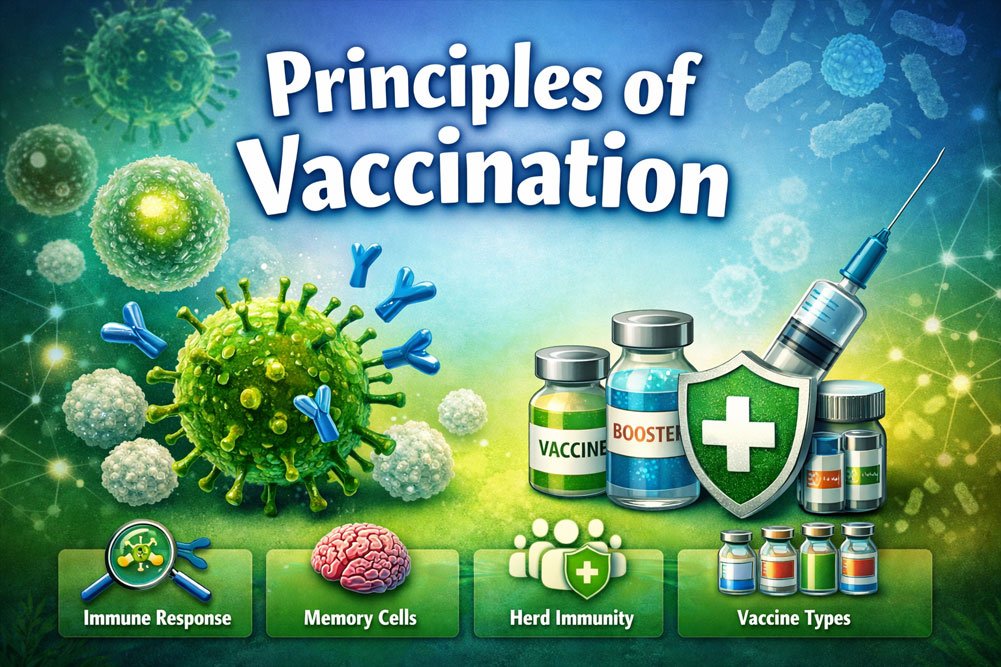
The Principles of Vaccination concept explains how vaccines protect the body from infectious diseases. It is based on the natural ability of the immune system to recognize harmful pathogens. Therefore, students studying biology and botany must understand these principles clearly. In addition, it helps in linking microbiology with public health concepts. You can easily download this note as a PDF using the link provided just below the post for quick access and offline reading.
Principles of Vaccination and Immune Response
The Principles Vaccination are based on how the immune system reacts to foreign substances. When a vaccine enters the body, it triggers a defense response. Therefore, the body learns to fight the pathogen effectively.
Basic Principles of Vaccination
Immune System Activation
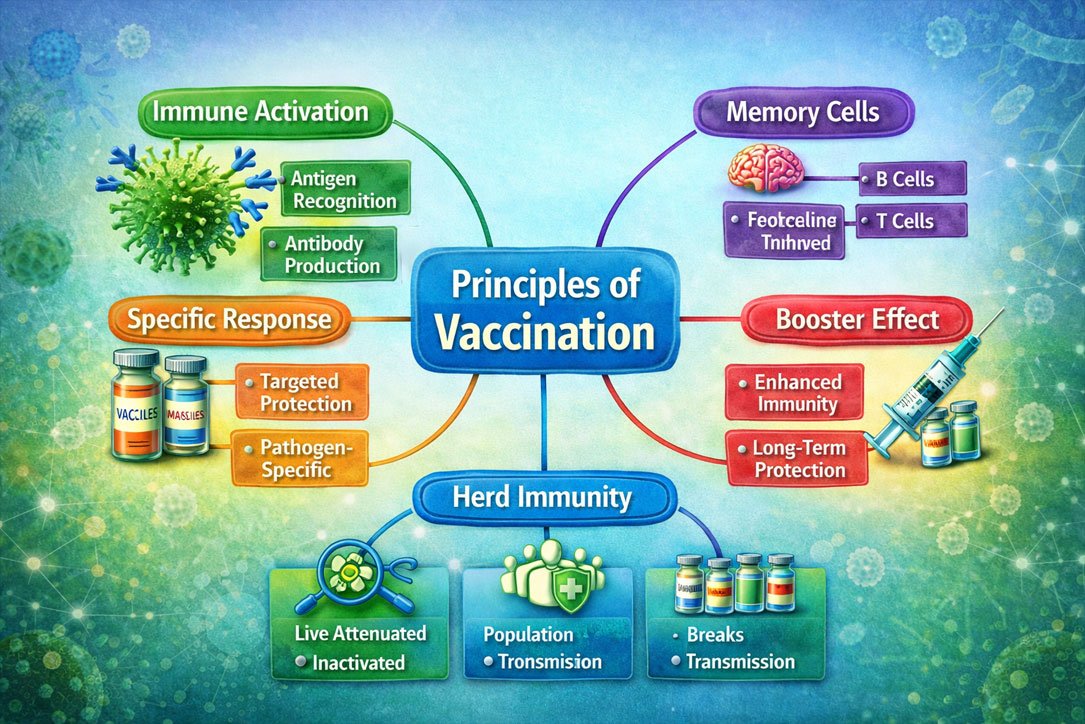
When a vaccine is introduced, it acts as an antigen. The immune system identifies it as foreign. As a result, it produces antibodies to destroy it.
These antibodies remain specific to the pathogen. Therefore, they provide protection during future infections.
Memory Cell Formation
After the initial response, the body forms memory cells. These include B cells and T cells.
These cells remain in the body for a long time. Thus, they respond quickly if the pathogen enters again.
Specificity of Response
Vaccines are highly specific. Each vaccine targets a particular pathogen.
For example, the measles vaccine protects only against the measles virus. Therefore, the immune response remains accurate and efficient.
Booster Effect
Some vaccines require booster doses. These doses strengthen the immune response.
Booster doses increase antibody levels. In addition, they improve memory cell function. Thus, they ensure long-lasting immunity.
Herd Immunity
Herd immunity occurs when most people are vaccinated. As a result, disease spread becomes limited.
This protects unvaccinated individuals as well. Therefore, it plays a major role in public health.
You may also like NOTES in... BOTANY BIOCHEMISTRY MOL. BIOLOGY ZOOLOGY MICROBIOLOGY BIOSTATISTICS ECOLOGY IMMUNOLOGY BIOTECHNOLOGY GENETICS EMBRYOLOGY PHYSIOLOGY EVOLUTION BIOPHYSICS BIOINFORMATICS
Types of Vaccines
Live Attenuated Vaccines
These vaccines contain weakened pathogens. They produce strong and long-lasting immunity.
Example: Measles vaccine
Inactivated Vaccines
These vaccines contain killed pathogens. They are safer but require booster doses.
Example: Polio vaccine
Subunit Vaccines
These vaccines include only parts of the pathogen, such as proteins.
Example: Hepatitis B vaccine
Toxoid Vaccines
These vaccines contain inactivated toxins produced by bacteria.
Example: Tetanus vaccine
Examples of Vaccination
- Polio vaccine helped reduce polio cases worldwide
- BCG vaccine protects against tuberculosis
- COVID-19 vaccines reduced disease severity
- HPV vaccine prevents certain cancers
Therefore, vaccination plays a key role in saving lives.
Importance of Vaccination
- Prevents infectious diseases
- Reduces disease severity
- Controls outbreaks
- Decreases death rates
- Promotes long-term immunity
In addition, it reduces healthcare costs and antibiotic use.
Vaccination in Plant Science
Although vaccination is mainly used in humans, similar ideas apply to plants.
Plants develop resistance through induced immunity. Scientists use biological agents to activate plant defense systems. Therefore, this concept is important for botany students.
Challenges in Vaccination
- Vaccine hesitancy
- Limited access in rural areas
- Storage difficulties
- Pathogen mutations
However, awareness and research are improving vaccination coverage.
Conclusion
The Principles Vaccination explain how the immune system protects the body from diseases. These principles include immune activation, memory, and specificity. Therefore, understanding Principles Vaccination is essential for biology and botany students to connect theory with real-world applications.
<<< Back to Microbiology Notes Page
You may also like... NOTES QUESTION BANK COMPETITIVE EXAMS. PPTs UNIVERSITY EXAMS DIFFERENCE BETWEEN.. MCQs PLUS ONE BIOLOGY NEWS & JOBS MOCK TESTS PLUS TWO BIOLOGY PRACTICAL
Study Offline!! Download this Note as a PDF
🌿 Dear Readers,
I hope you found this article helpful and easy to understand. If you have any questions, suggestions, or thoughts, I would truly love to hear from you.
Please share your feedback in the comments below. Your participation helps make EasyBiologyClass a better learning space for everyone.
Best regards,
EasyBiologyClass