
notes on adaptive radiation

Adaptive Radiation in Evolution and Its Role in Speciation with Examples

Adaptive radiation is the rapid diversification of organisms into new forms when environmental changes create new opportunities or challenges. Examples include the Galápagos finches, studied by Charles Darwin, which evolved various beak shapes for different food sources, and the cichlid fish in Africa’s Great Lakes, which diversified into hundreds of species. This process highlights the adaptability and resilience of life, driving biodiversity and the evolution of new species.

Continue Reading
convergent evolution notes

Understanding Convergent Evolution with Examples

Convergent evolution is a captivating phenomenon that highlights the incredible adaptability of life on Earth. This process occurs when unrelated organisms independently develop similar traits or characteristics, despite having different evolutionary histories. By examining convergent evolution, we gain insight into the ingenious ways evolutionary mechanisms work and how similar outcomes can emerge from vastly different starting points.

Continue Reading
mcq on wood anatomy

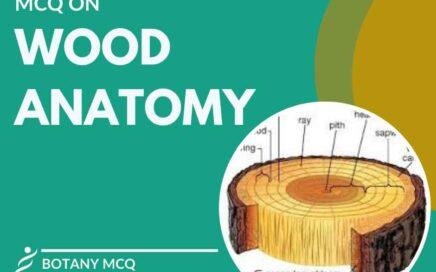
MCQ on Wood Anatomy

Wood anatomy is the study of the structure and organization of wood tissues. It includes examining cells like vessels, tracheids, fibers, and rays that form the xylem for water transport and support. It aids in species identification and understanding wood properties. This is an MCQ on Wood Anatomy. Botany Notes  […]

Continue Reading
MCQ on Anatomy of Monocot Stem

MCQ on Anatomy of Monocot Stem

A monocot stem consists of epidermis with stomata, a scattered arrangement of vascular bundles containing xylem and phloem, and ground tissue. The stem lacks secondary growth due to the absence of a vascular cambium. A cuticle covers the epidermis. This is an MCQ on Anatomy of Monocot Stem with Answer […]

Continue Reading
MCQ on Anatomy of Monocot Leaf

MCQ on Anatomy of Monocot Root

A monocot root comprises an epidermis with root hairs, a cortex for storage, and an endodermis with a Casparian strip. The vascular cylinder contains xylem and phloem arranged in a ring. Root cap protects the growing tip, aiding in soil penetration. This is an MCQ on Anatomy of Monocot Root. […]

Continue Reading