
Synapomorphy vs Plesiomorphy: Clear Evolution Guide
Introduction
Synapomorphy vs Plesiomorphy is one of the most important distinctions in evolutionary biology. However, many students confuse these terms. If you study phylogenetics, taxonomy, or systematics, you must understand this difference clearly. These concepts help scientists build accurate evolutionary trees. Therefore, mastering them improves your understanding of biological classification. You can easily download this note as a PDF using the link provided just below the post for quick access and offline reading.
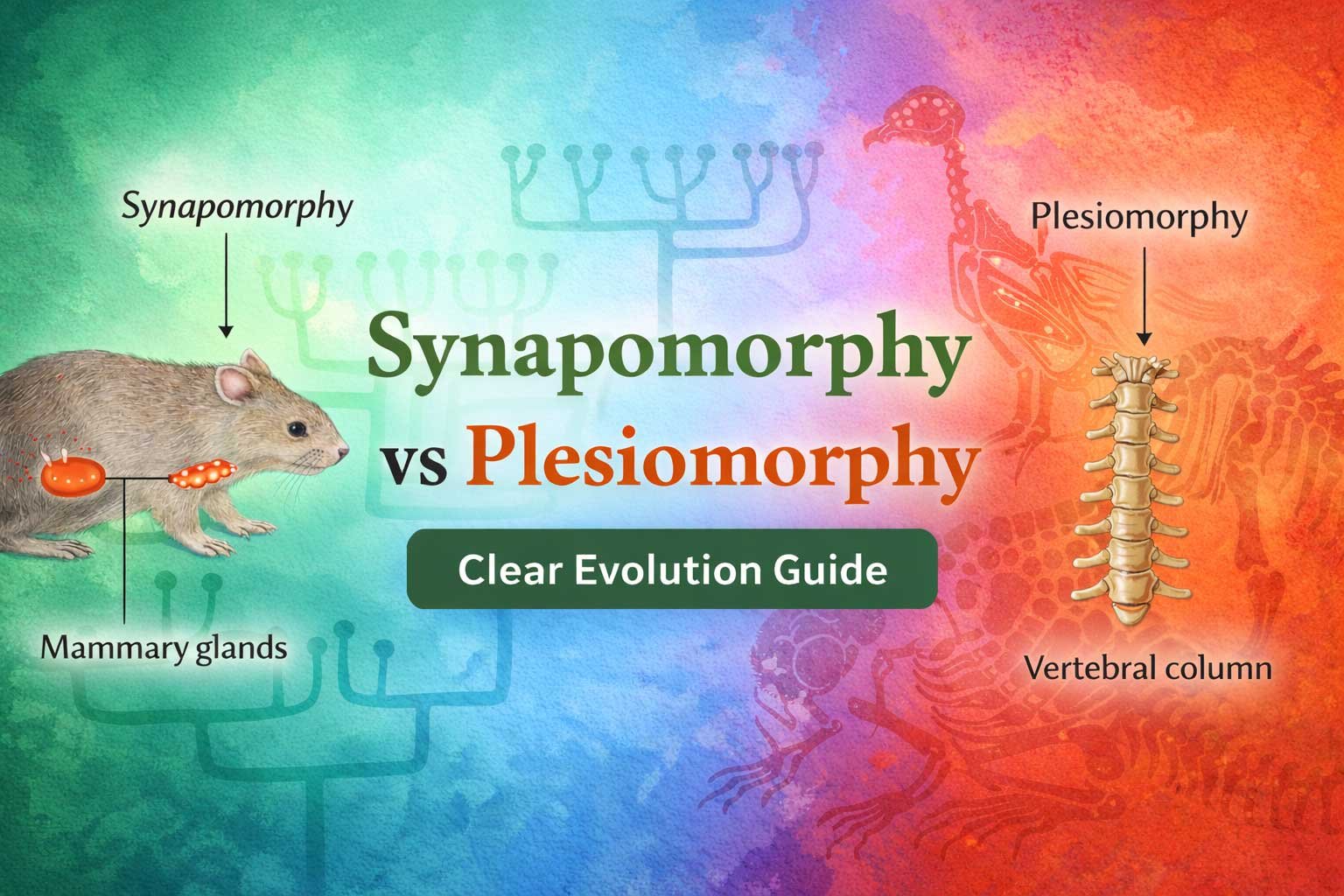
Definition: Synapomorphy vs Plesiomorphy explains two types of character states in evolution. A synapomorphy is a shared derived trait that defines a clade. In contrast, a plesiomorphy is an ancestral trait inherited from distant ancestors and does not define evolutionary groups.
What Is Synapomorphy vs Plesiomorphy in Evolutionary Terms?
To understand Synapomorphy vs Plesiomorphy, we must examine character origin.
What Is a Synapomorphy?
A synapomorphy is a shared derived character state.
- “Syn” means shared.
- “Apo” means derived or new.
- “Morphy” means form or trait.
In simple terms, it is a trait that evolved in a common ancestor and appears in its descendants. However, it was absent in earlier ancestors.
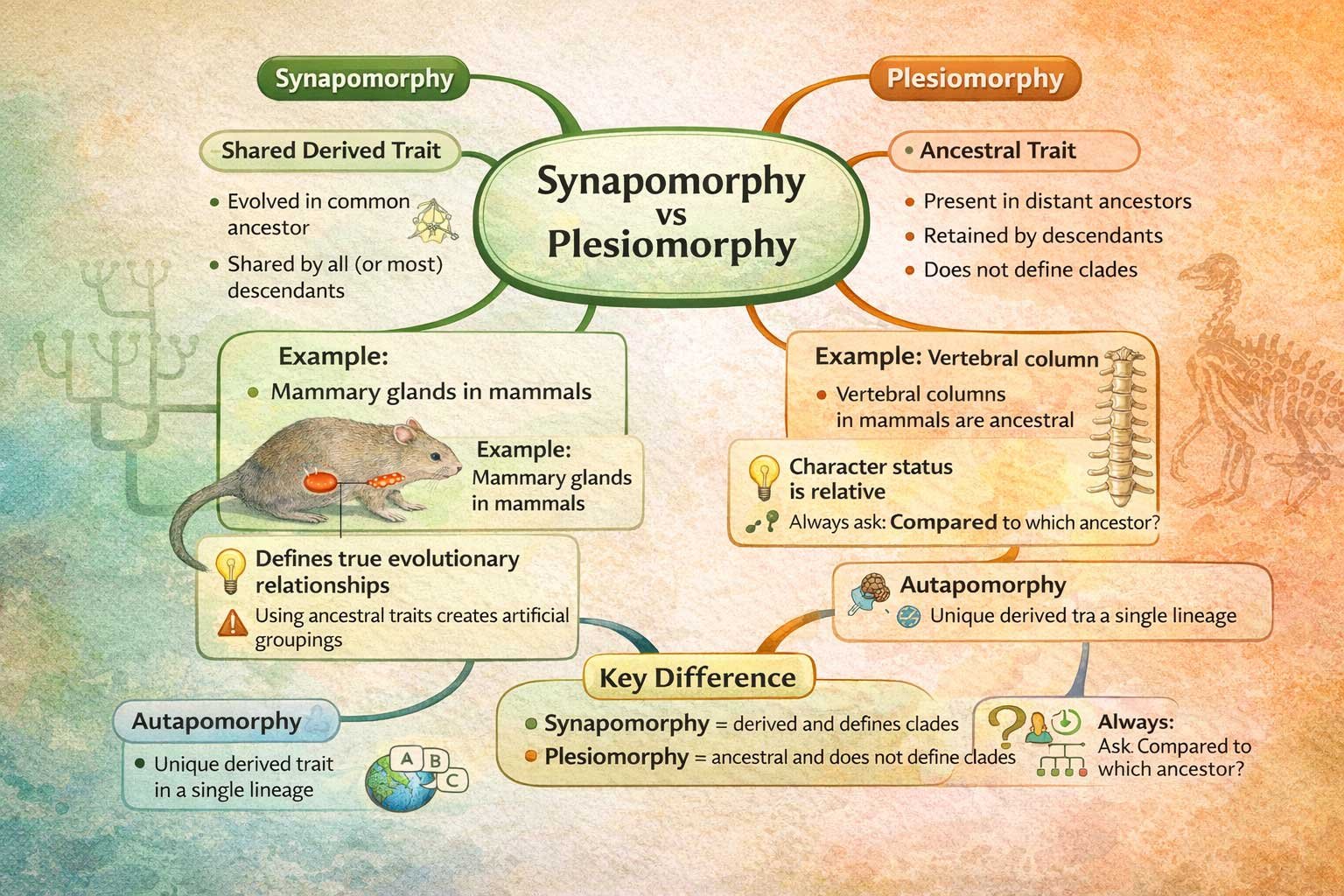
Synapomorphies form the foundation of modern cladistics. They define evolutionary groups called clades.
You may also like NOTES in... BOTANY BIOCHEMISTRY MOL. BIOLOGY ZOOLOGY MICROBIOLOGY BIOSTATISTICS ECOLOGY IMMUNOLOGY BIOTECHNOLOGY GENETICS EMBRYOLOGY PHYSIOLOGY EVOLUTION BIOPHYSICS BIOINFORMATICS
Example: Mammary Glands in Mammals
All members of Mammalia possess mammary glands. This feature evolved in their common ancestor. It distinguishes mammals from reptiles, birds, amphibians, and fish.
Therefore, mammary glands are a synapomorphy of mammals.
Without synapomorphies, scientists cannot construct meaningful phylogenetic trees.
What Is a Plesiomorphy?
A plesiomorphy is an ancestral character state.
- “Plesio” means ancestral or near.
- “Morphy” means form.
It refers to a trait that existed in distant ancestors and continues in descendant groups. However, it is not unique to the group being studied.
Plesiomorphies do not define clades.
Example: Vertebral Column
A vertebral column is present in Mammalia, Reptilia, Aves, and Amphibia. However, this structure evolved earlier in the common ancestor of vertebrates.
Thus, within mammals, the backbone is a plesiomorphy, not a synapomorphy.
Why Synapomorphy vs Plesiomorphy Matters in Cladistics
The distinction between Synapomorphy vs Plesiomorphy is critical in evolutionary systematics.
Only synapomorphies define true evolutionary relationships. If scientists group organisms using plesiomorphic traits, the classification becomes artificial.
The Classic Reptile Problem
Traditionally, reptiles excluded birds. However, birds evolved from reptilian ancestors. Traits such as scales are ancestral within that lineage. Therefore, they are plesiomorphic traits.
Modern cladistics shows that excluding birds makes Reptilia paraphyletic. Consequently, evolutionary classification must rely on shared derived traits.
Quick Comparison Table
| Feature | Synapomorphy | Plesiomorphy |
|---|---|---|
| Definition | Shared derived trait | Ancestral trait |
| Evolutionary status | Newly evolved | Present in distant ancestors |
| Role in phylogeny | Defines clades | Does not define clades |
| Example in mammals | Mammary glands | Vertebral column |
Character States Are Relative
A trait is not permanently synapomorphic or plesiomorphic. Instead, its status depends on the comparison level.
- Four limbs are a synapomorphy of tetrapods.
- However, within mammals, four limbs are plesiomorphic.
Therefore, always ask: compared to which ancestor?
This relative nature often causes confusion among students.
Related Concept: Autapomorphy
An autapomorphy is a derived trait unique to a single lineage.
For example, complex language ability is an autapomorphy of Homo sapiens.
Autapomorphies help identify species. However, they do not define broader clades.
Practical Tips for Students
If you are constructing phylogenetic trees:
- Focus on derived characters.
- Determine character polarity carefully.
- Use an outgroup to identify ancestral states.
Incorrect character analysis leads to faulty evolutionary trees. Therefore, always think historically:
- When did the trait evolve?
- Which groups inherited it?
- Which groups lacked it earlier?
Conclusion
Understanding Synapomorphy vs Plesiomorphy is essential for accurate phylogenetic analysis. A synapomorphy represents a shared evolutionary innovation. In contrast, a plesiomorphy represents an inherited ancestral condition.
Remember this key rule: shared ancestry is supported by shared derived traits, not merely shared traits.
Mastering Synapomorphy vs Plesiomorphy will significantly improve your understanding of evolutionary relationships.
You may also like... NOTES QUESTION BANK COMPETITIVE EXAMS. PPTs UNIVERSITY EXAMS DIFFERENCE BETWEEN.. MCQs PLUS ONE BIOLOGY NEWS & JOBS MOCK TESTS PLUS TWO BIOLOGY PRACTICAL
Study Offline!! Download this Note as a PDF
🌿 Dear Readers,
I hope you found this article helpful and easy to understand. If you have any questions, suggestions, or thoughts, I would truly love to hear from you.
Please share your feedback in the comments below. Your participation helps make EasyBiologyClass a better learning space for everyone.
Best regards,
EasyBiologyClass