
Principles of Systematics: Core Components Explained for Botany Students
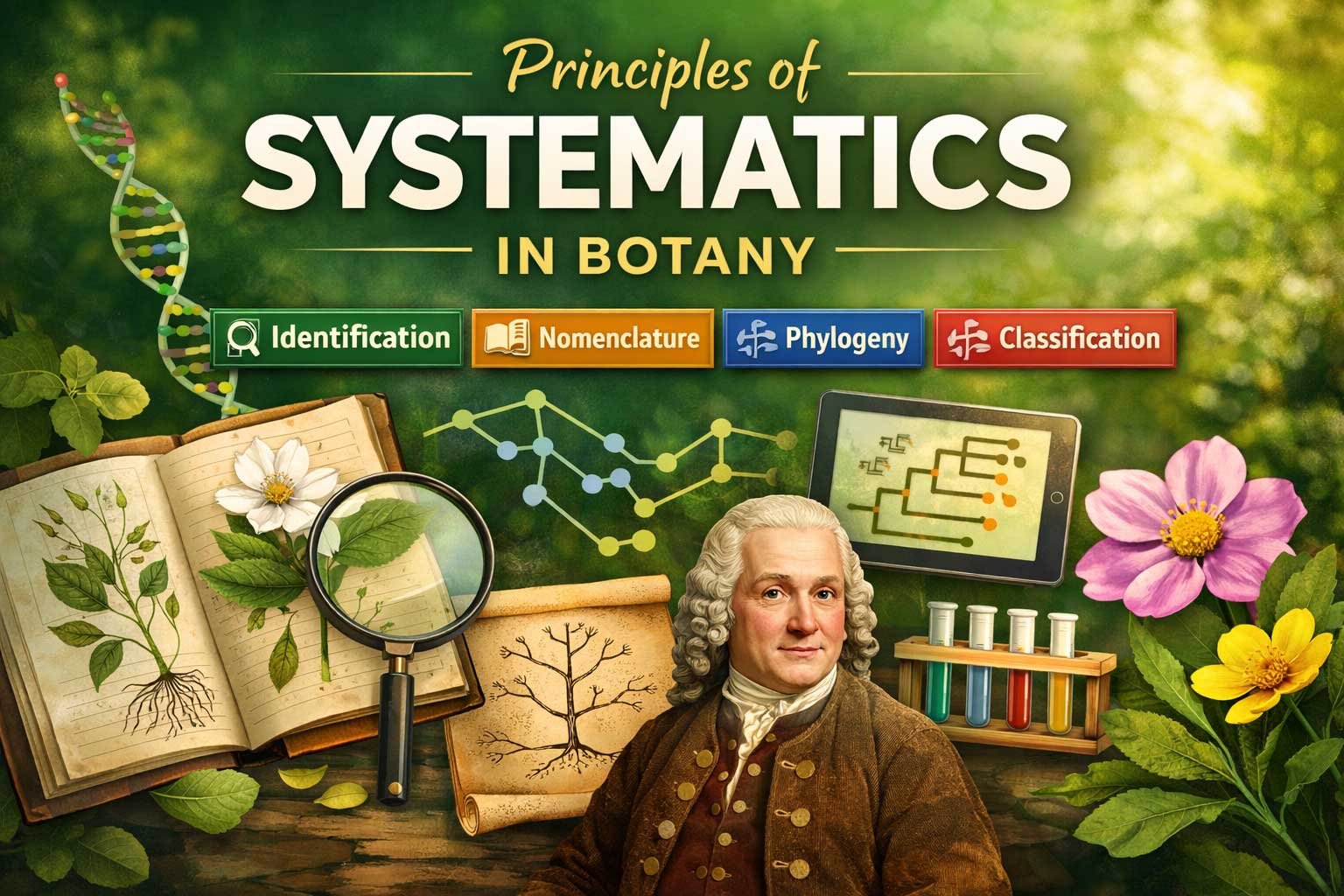
Systematics is a fundamental branch of plant science that aims to organize plant diversity into a meaningful and scientifically sound classification system. It is not limited to naming plants; instead, it integrates identification, description, nomenclature, phylogeny, and classification to understand relationships among organisms. This article explains the basic principles of systematics in a clear and structured manner for students of botany. You can easily download this note on Principles of Systematics in Botany as a PDF using the link provided just below the post for quick access and offline reading.
Taxonomy Notes | Taxonomy PPTs | Taxonomy MCQs
1. Identification
What is Identification?
Identification is the process of recognizing an unknown plant specimen and determining its correct scientific name. It involves placing the specimen into an existing classification system at the appropriate rank.
In simple terms, identification answers the question: “What plant is this?”
How is Identification Done?
Identification can be carried out through:
- Comparing specimens with authenticated herbarium collections
- Consulting experts in specific plant groups
- Using botanical literature such as floras, manuals, and monographs
- Applying identification keys provided in reference books
After using a key to arrive at a tentative name, the identification is confirmed by matching the specimen with detailed descriptions available in scientific literature.
Modern Digital Identification
With technological advancements, identification has become more collaborative. Botanists now share plant photographs through online platforms and professional groups, where experts can provide opinions and corrections. This has made plant identification faster and more accessible.
2. Description
Purpose of Description
Description involves recording the observable features of a plant taxon in a systematic format. It provides a scientific account of a plant’s characteristics.
A complete description includes features such as:
- Habit
- Stem
- Leaves
- Flowers
- Sepals and petals
- Stamens and carpels
- Fruits
Each feature (character) is recorded along with its condition (character state). For example, flower colour may be white, yellow, or red.
You may also like NOTES in... BOTANY BIOCHEMISTRY MOL. BIOLOGY ZOOLOGY MICROBIOLOGY BIOSTATISTICS ECOLOGY IMMUNOLOGY BIOTECHNOLOGY GENETICS EMBRYOLOGY PHYSIOLOGY EVOLUTION BIOPHYSICS BIOINFORMATICS
Diagnosis and Diagnostic Characters
A shorter form of description focusing only on distinguishing features is called a diagnosis. The traits that separate one taxon from closely related taxa are known as diagnostic characters. These characters define the boundaries or circumscription of the taxon.
Describing Fresh and Dried Specimens
Fresh plant materials are easy to describe. However, dried specimens often need to be softened before detailed examination, especially for floral dissection.
3. Nomenclature
Meaning of Nomenclature
Nomenclature refers to the system of assigning correct scientific names to organisms according to internationally accepted rules.
For plants, naming follows the rules laid down in the International Code of Botanical Nomenclature (now updated as the International Code of Nomenclature for algae, fungi, and plants). This code ensures:
- Stability of names
- Uniformity in usage
- Selection of one correct name among many synonyms
Cultivated plants follow a separate code designed specifically for horticultural varieties. Similarly, animals, bacteria, and viruses have their own naming codes.
Modern Developments in Nomenclature
Efforts have been made to create a unified system for naming all living organisms. The Draft BioCode represents such an attempt. Another modern development is the PhyloCode, which proposes naming groups based on evolutionary relationships rather than fixed hierarchical ranks.
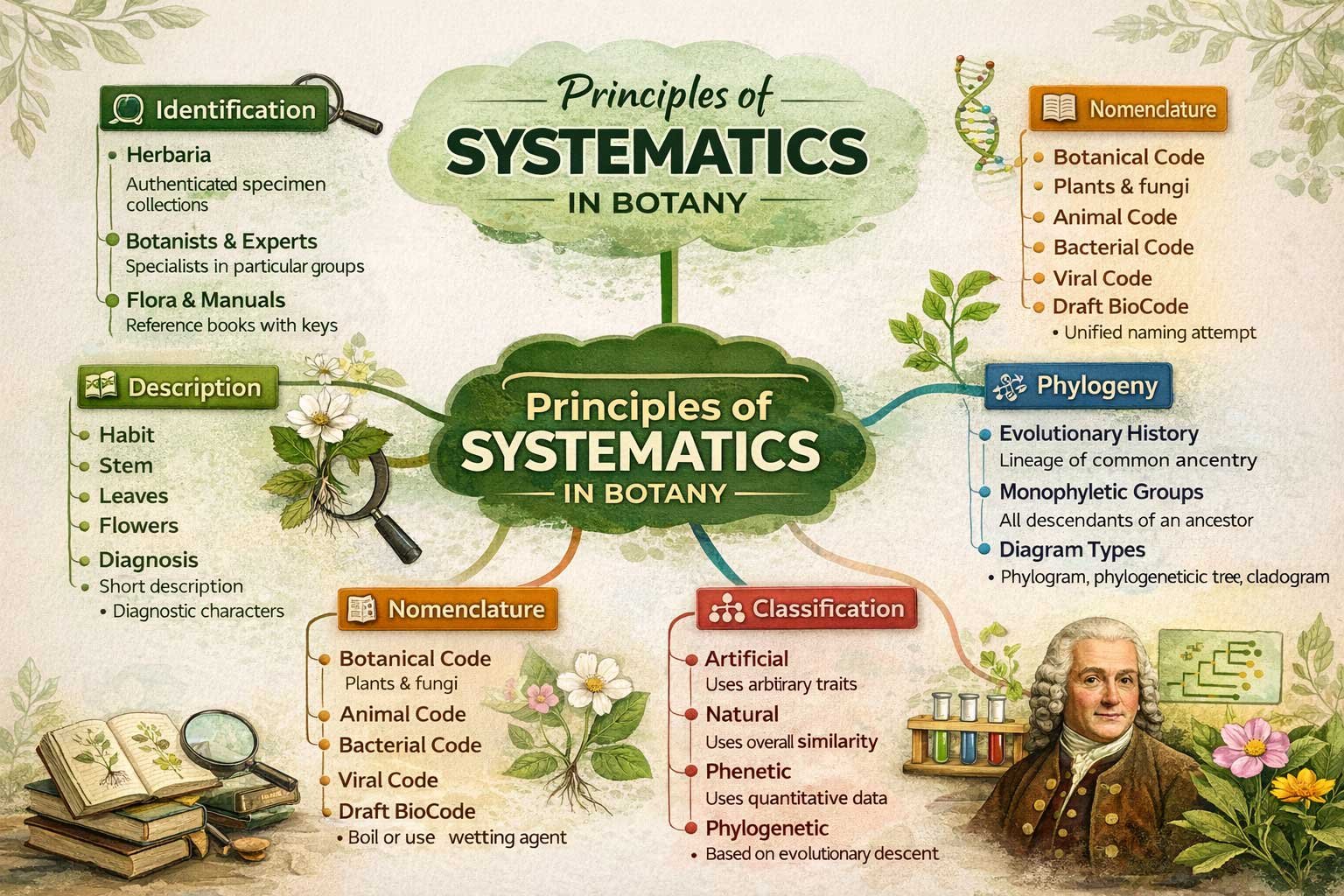
4. Phylogeny
Understanding Phylogeny
Phylogeny is the study of evolutionary history and ancestral relationships among organisms. It explains how different taxa are connected through common ancestry.
Phylogenetic relationships are usually represented through diagrams such as:
- Phylograms – showing evolutionary advancement
- Phylogenetic trees – incorporating geological time
- Cladograms – constructed using shared derived characters
Monophyletic, Paraphyletic, and Polyphyletic Groups
Modern systematics emphasizes recognizing monophyletic groups, which include all descendants of a common ancestor.
- Paraphyletic groups exclude some descendants and are usually reorganized.
- Polyphyletic groups consist of members from different ancestral lines and are split into separate groups.
Accurate phylogenetic grouping ensures that classification truly reflects evolutionary history.
5. Classification
What is Classification?
Classification is the arrangement of organisms into groups based on similarities and relationships. These groups are organized into hierarchical categories such as:
- Species
- Genus
- Family
- Order
- Class
- Division
This ranked system is traditionally known as the Linnaean system.
Dynamic Nature of Classification
Classification is not fixed. It may involve:
- Describing new taxa
- Dividing existing groups
- Merging related taxa
- Changing ranks
- Reassigning positions
A good classification system allows efficient storage and retrieval of biological information.
Major Approaches to Classification
1. Artificial Classification
Artificial systems use a limited number of easily observable traits, such as number of stamens or growth habit. These systems are simple but do not reflect natural relationships.
2. Natural Classification
Natural systems group organisms based on overall similarity. Earlier systems relied mainly on morphology, but modern approaches consider multiple lines of evidence.
3. Phenetic Classification
Phenetic systems use quantitative data from many fields such as morphology, anatomy, embryology, phytochemistry, and ultrastructure. These systems emphasize overall similarity without necessarily considering evolutionary history.
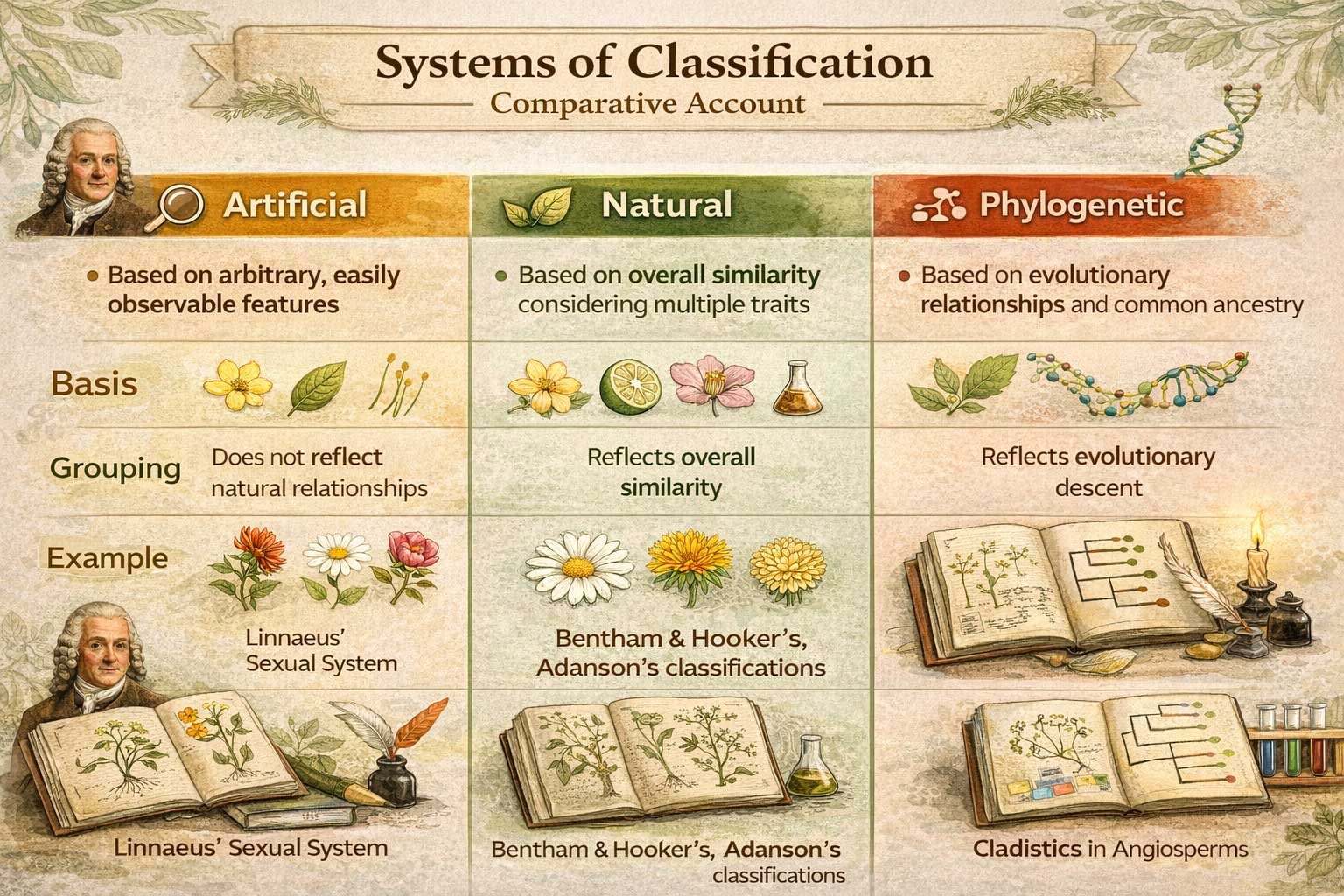
4. Phylogenetic Classification
Phylogenetic classification is based on evolutionary descent. It ensures that groups are monophyletic. If a group is found to be paraphyletic or polyphyletic, it is reorganized to reflect true ancestry. This approach, known as cladistics, is widely used today.
5. Evolutionary Classification
Evolutionary systems combine phylogenetic relationships with the degree of morphological difference between groups. In some cases, paraphyletic groups may be retained if differences are considered significant.
Modern Trends in Systematics
Contemporary systems integrate phylogenetic principles with phenetic data. Some scientists have proposed replacing the traditional ranked hierarchy with a rank-free phylogenetic taxonomy, where groups are defined strictly by common ancestry.
Importance and Predictive Value of Classification
A well-constructed classification system has predictive power. For example, if one species in a genus contains a valuable chemical compound, related species may also possess similar compounds.
The more accurately classification reflects evolutionary relationships, the stronger its predictive value.
A truly natural classification is one that:
- Represents evolutionary history
- Recognizes monophyletic groups
- Uses evidence from multiple scientific disciplines
- Reflects both phylogenetic relationships and overall similarity
Conclusion
The principles of systematics—identification, description, nomenclature, phylogeny, and classification—work together to organize plant diversity scientifically. Systematics is not a static subject; it evolves as new evidence emerges.
For botany students, understanding these principles is essential. They provide the foundation for research, biodiversity studies, conservation work, and applied plant sciences. Systematics ultimately helps us interpret and manage the vast diversity of the plant kingdom in a logical and meaningful way.
FAQ with answers on Principles of Systematics
1. What is systematics in botany?
Systematics is a branch of plant science that organizes plant diversity into a meaningful and scientific classification system. It includes identification, description, nomenclature, phylogeny, and classification to understand relationships among plants.
2. How does identification differ from classification?
Identification involves determining the correct scientific name of an unknown plant specimen by comparing it with existing references. Classification, on the other hand, is the arrangement of plants into hierarchical groups such as species, genus, family, and order based on similarities and relationships.
3. What is the role of nomenclature in systematics?
Nomenclature ensures that plants are given correct and universally accepted scientific names according to internationally agreed rules. It promotes stability, uniformity, and the selection of one correct name among synonyms.
4. Why is phylogeny important in modern systematics?
Phylogeny studies the evolutionary history and ancestral relationships among plants. Modern systematics emphasizes recognizing monophyletic groups so that classification accurately reflects evolutionary descent.
5. What is the difference between artificial and phylogenetic classification?
Artificial classification uses a limited number of easily observable traits and does not reflect natural relationships. Phylogenetic classification is based on evolutionary descent and ensures that groups are monophyletic, reflecting true ancestry.
Test Your Understanding of Principles of Systematics with this MCQ
1. What is the primary goal of identification in systematics?
A. To classify plants into hierarchical ranks
B. To determine the evolutionary history of plants
C. To recognize an unknown plant specimen and assign its correct scientific name
D. To describe plant morphology in detail
Answer: C
2. Which of the following tools is commonly used for plant identification?
A. Geological maps
B. Identification keys
C. Weather charts
D. Soil pH meters
Answer: B
3. In plant description, a “character state” refers to:
A. The habitat of the plant
B. The evolutionary origin of the plant
C. The condition or form of a character
D. The taxonomic rank of a plant
Answer: C
4. A shorter description that focuses only on distinguishing features is called:
A. Monograph
B. Flora
C. Diagnosis
D. Key
Answer: C
5. Scientific naming of plants is governed by which code?
A. International Code of Zoological Nomenclature
B. Draft BioCode
C. PhyloCode
D. International Code of Nomenclature for algae, fungi, and plants
Answer: D
6. A group that includes all descendants of a common ancestor is called:
A. Polyphyletic
B. Artificial
C. Monophyletic
D. Paraphyletic
Answer: C
7. Which diagram is constructed using shared derived characters?
A. Phylogram
B. Cladogram
C. Herbarium sheet
D. Monograph
Answer: B
8. The traditional ranked system of classification is known as the:
A. PhyloCode system
B. Phenetic system
C. Linnaean system
D. Draft BioCode system
Answer: C
9. Artificial classification systems are mainly based on:
A. Evolutionary descent
B. Overall similarity from multiple data sources
C. A limited number of easily observable traits
D. Molecular phylogeny
Answer: C
10. A well-constructed classification system has predictive value because it:
A. Eliminates the need for further research
B. Predicts ecological disasters
C. Helps infer characteristics of related species
D. Fixes taxonomic ranks permanently
Answer: C
<<< Back to Plant Systematics Notes Page
You may also like... NOTES QUESTION BANK COMPETITIVE EXAMS. PPTs UNIVERSITY EXAMS DIFFERENCE BETWEEN.. MCQs PLUS ONE BIOLOGY NEWS & JOBS MOCK TESTS PLUS TWO BIOLOGY PRACTICAL
Study Offline!! Download this Note in PDF
🌿 Dear Readers,
I hope you found this article helpful and easy to understand. If you have any questions, suggestions, or thoughts, I would truly love to hear from you.
Please share your feedback in the comments below. Your participation helps make EasyBiologyClass a better learning space for everyone.
Best regards,
EasyBiologyClass