
Type Method Taxonomy (Nomenclatural Type)
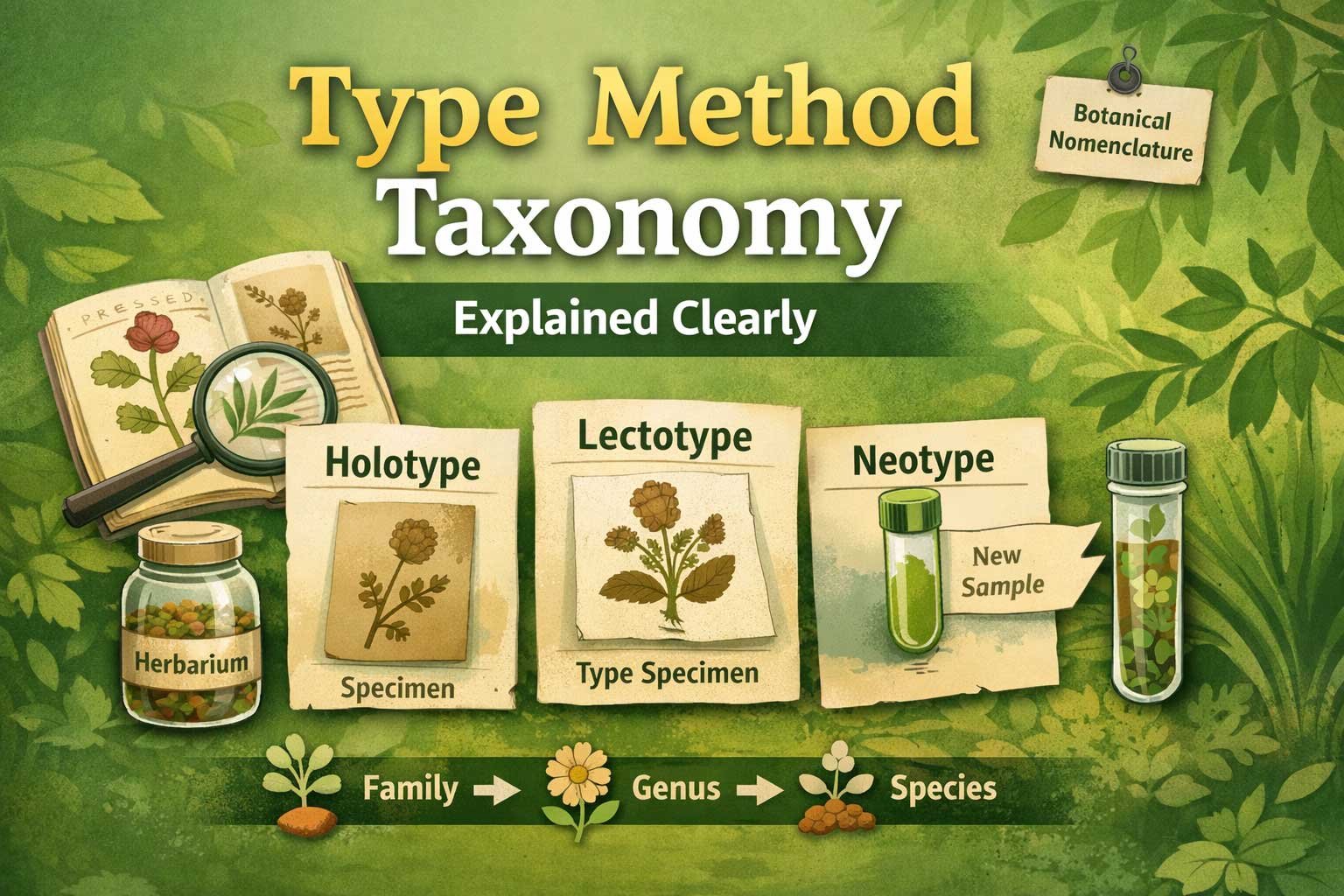
Type Method Taxonomy is a fundamental principle of biological classification. It ensures that each taxonomic name is permanently linked to a specific representative. Therefore, it maintains stability and clarity in naming organisms. In botanical nomenclature, this method plays a central role in identifying families, genera, and species correctly. Understanding this concept helps students avoid confusion in taxonomy. You can easily download this note as a PDF using the link provided just below the post for quick access and offline reading.
Taxonomy Notes | Taxonomy PPTs | Taxonomy MCQs
Definition
Type Method Taxonomy is a system in biological classification where each taxonomic name is permanently attached to a specific representative specimen or taxon. This representative, known as the type, fixes the application of a name but does not necessarily represent the most typical member of the group.
What is Type Method Taxonomy?
Type Method Taxonomy assigns a name to a taxon based on a designated representative called the type. This process is known as typification. However, the type does not need to be the most common or typical member. Instead, it simply fixes the name of the taxon permanently.
For example:
- The family Theaceae is derived from the synonym Thea.
- The correct genus name is Camellia.
- Mimosa serves as the type genus of Mimosaceae, although it differs in flower structure.
Thus, the type ensures naming stability even if classification changes.
Types in Higher Taxonomic Categories
In higher taxonomic ranks such as families, the type is always a genus.
- Urticaceae is based on the genus Urtica.
- When a large family splits, the name remains with the group containing the type genus.
- Moraceae → Type genus Morus
- Ulmaceae → Type genus Ulmus
- Cannabaceae → Type genus Cannabis
Therefore, the type genus determines the family name permanently.
Type in Genus and Species
The type of a genus is a species. For example, Poa pratensis is the type species of the genus Poa.
The type of a species or infraspecific taxon is usually:
- A single preserved specimen
- Stored in a recognized herbarium
- Properly labeled with collector name, location, and collection number
In some cases, an illustration may also serve as the type. Importantly, type specimens must be permanently preserved. Living plants cannot serve as types. However, preserved fungal or algal cultures are accepted if kept metabolically inactive.
You may also like NOTES in... BOTANY BIOCHEMISTRY MOL. BIOLOGY ZOOLOGY MICROBIOLOGY BIOSTATISTICS ECOLOGY IMMUNOLOGY BIOTECHNOLOGY GENETICS EMBRYOLOGY PHYSIOLOGY EVOLUTION BIOPHYSICS BIOINFORMATICS
Kinds of Type Specimens in Type Method Taxonomy
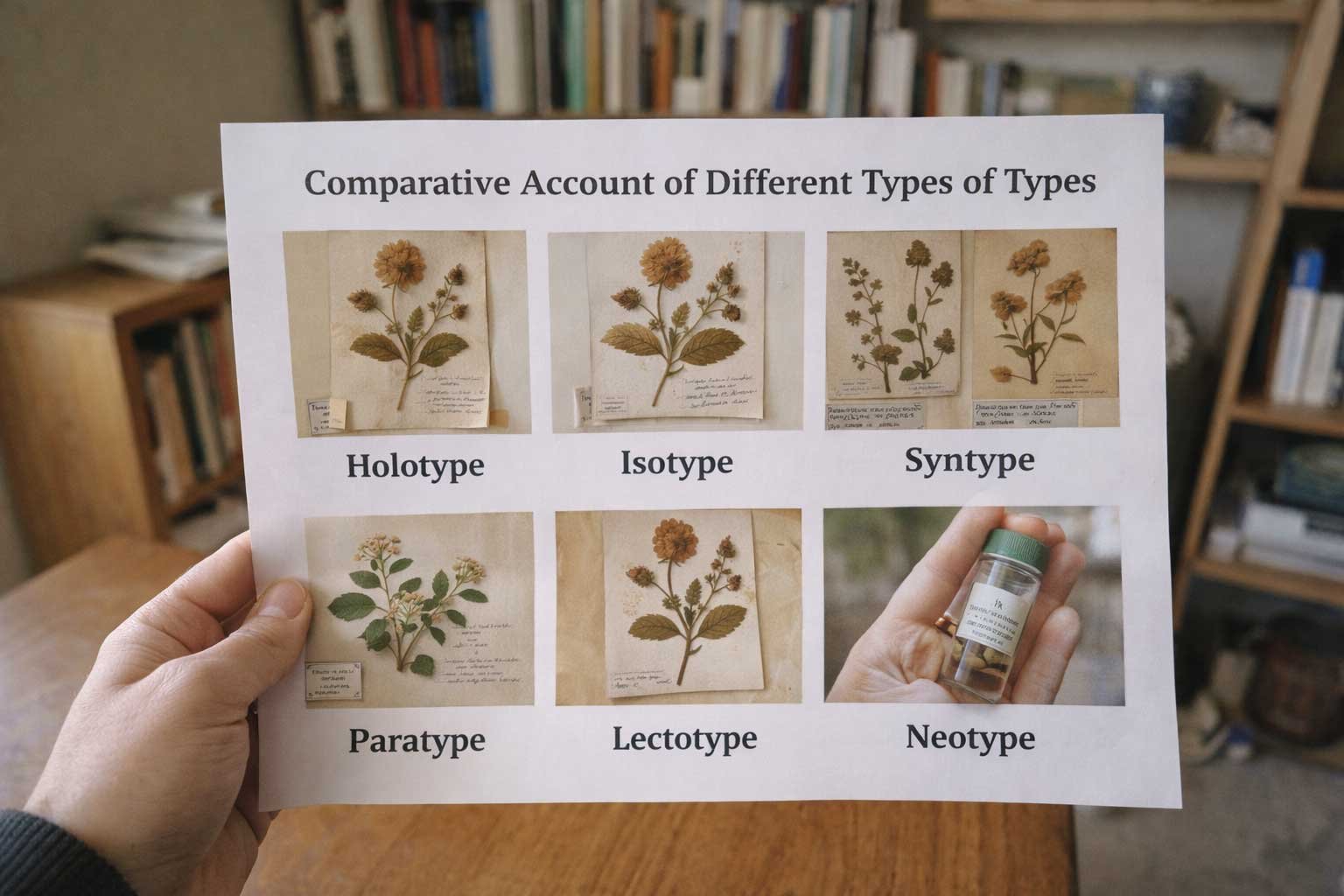
1. Holotype
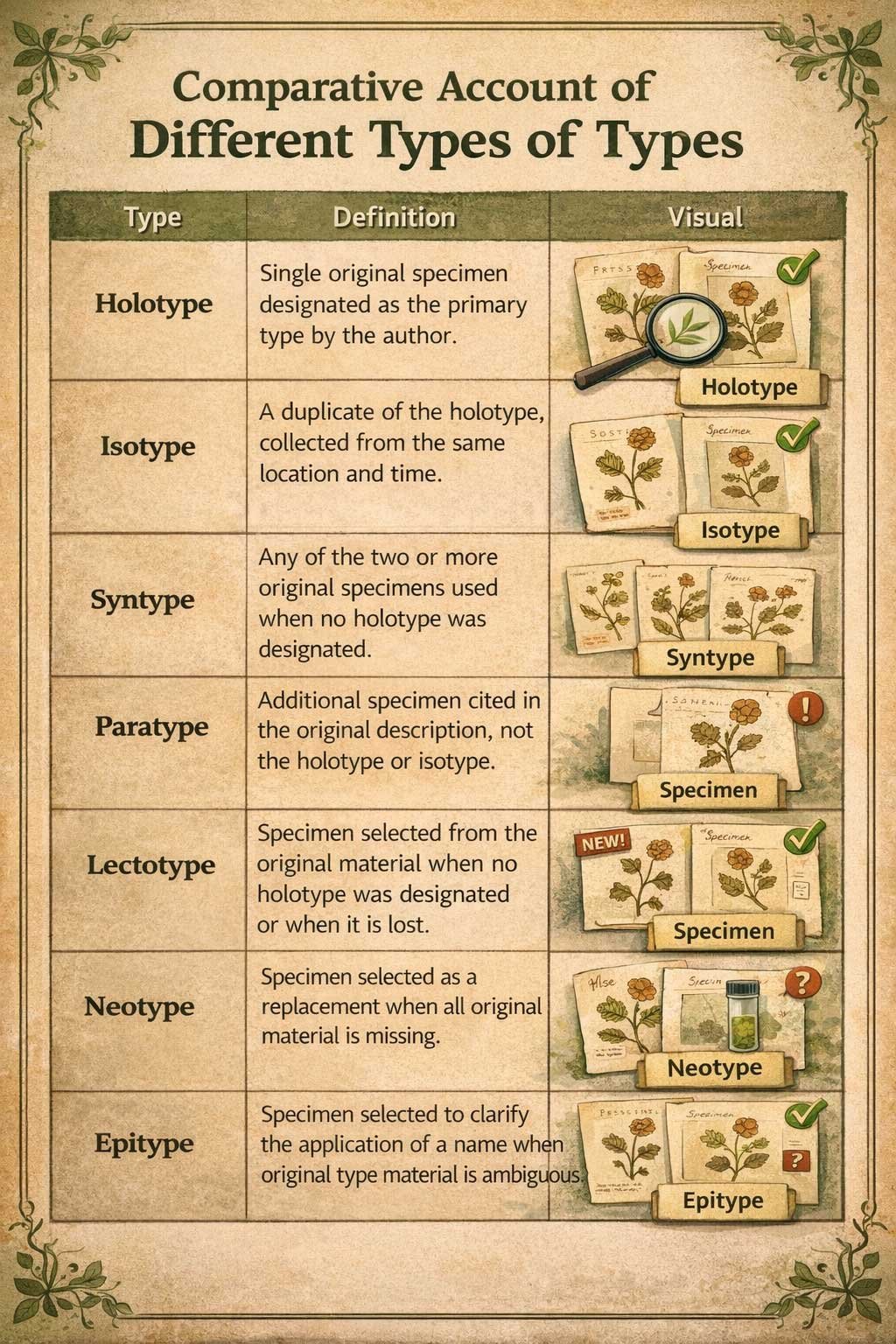
A holotype is the single specimen designated by the author when describing a new species. It must be clearly indicated at publication and represents one collection made at one time. Today, designating a holotype is mandatory.
2. Isotype
An isotype is a duplicate of the holotype. It is collected at the same time, from the same location, and by the same collector. Thus, it serves as supporting evidence.
3. Syntype
A syntype exists when no holotype was designated and two or more specimens were cited in the original description. Each cited specimen becomes a syntype.
4. Paratype
A paratype is a specimen cited in the original description but is neither the holotype, isotype, nor syntype. It provides additional reference material.
5. Lectotype
A lectotype is selected later when no holotype was originally designated or when the holotype has been lost or destroyed. It must be chosen from original material such as isotypes or syntypes.
6. Neotype
A neotype is designated when all original material is missing. It acts as a new reference specimen to stabilize the name.
7. Epitype
An epitype is selected when existing type material is ambiguous and cannot be clearly identified. The original type must always be cited when designating an epitype.
Additional Terminology
Topotype
A specimen collected from the same locality as the holotype.
Ex-type
Living material derived from a preserved type culture. However, it is not itself the nomenclatural type.
Autonym and Autotype
When an infraspecific taxon is created for the first time, the group containing the original type automatically receives the same epithet. This name is called an autonym, and the specimen is called an autotype. For example, Acacia nilotica ssp. nilotica.
Type Method vs Typology
It is important to distinguish Type Method Taxonomy from typology. Typology assumes that one ideal specimen represents a species and ignores variation. However, modern taxonomy recognizes variation. Therefore, the type method only fixes the name and does not define an ideal organism.
Importance of Type Method Taxonomy
Type Method Taxonomy ensures stability in naming, scientific accuracy, and consistency across taxonomic revisions. Without this method, classification would become unstable after revisions. Therefore, typification remains essential in botanical nomenclature.
Conclusion
Type Method Taxonomy provides a stable and scientific system for naming organisms. It permanently links each taxon to a specific type specimen or genus. Therefore, even when classifications change, names remain consistent. Understanding this concept is essential for mastering plant taxonomy and botanical nomenclature.
<<< Back to Plant Systematics Note Page
You may also like... NOTES QUESTION BANK COMPETITIVE EXAMS. PPTs UNIVERSITY EXAMS DIFFERENCE BETWEEN.. MCQs PLUS ONE BIOLOGY NEWS & JOBS MOCK TESTS PLUS TWO BIOLOGY PRACTICAL
Study Offline!! Download this Note as a PDF
🌿 Dear Readers,
I hope you found this article helpful and easy to understand. If you have any questions, suggestions, or thoughts, I would truly love to hear from you.
Please share your feedback in the comments below. Your participation helps make EasyBiologyClass a better learning space for everyone.
Best regards,
EasyBiologyClass