Louis Pasteur Contributions Explained Simply
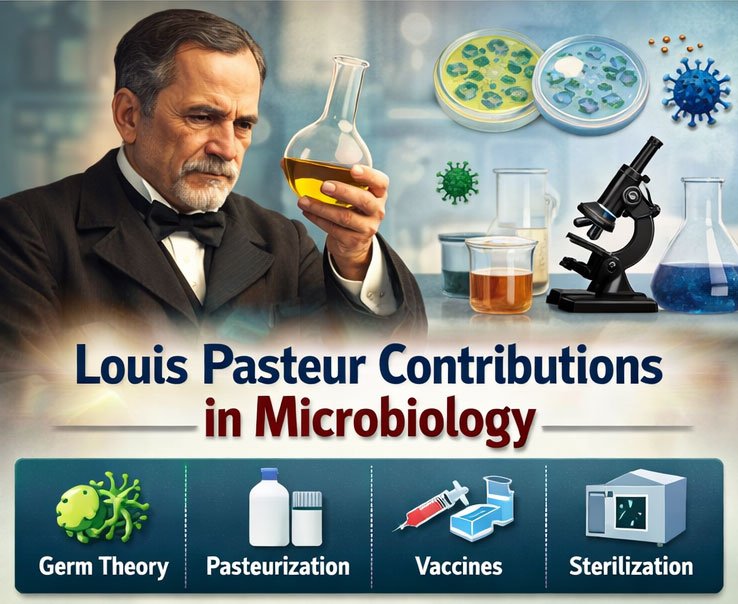
Louis Pasteur contributions changed the field of microbiology forever. He transformed medical science through his discoveries. Moreover, his work helped scientists understand microorganisms and diseases. Therefore, students must learn his achievements to understand modern microbiology clearly. You can easily download this note as a PDF using the link provided just below the post for quick access and offline reading.
Louis Pasteur contributions refer to the major scientific discoveries made by Louis Pasteur in microbiology. These include germ theory, pasteurization, and vaccine development. His work established the role of microorganisms in disease and laid the foundation for modern medical and laboratory practices.
Louis Pasteur Contributions in Microbiology
Early Life and Background
Louis Pasteur was born on December 27, 1822, in Dole, France. His father worked as a tanner. Initially, he studied chemistry. However, his research on fermentation led him to explore microorganisms. As a result, he became one of the most important scientists in history.
He is widely known as the Father of Microbiology. This is because his work established microbiology as a separate scientific discipline.
Key Scientific Contributions
1. Coining the Term Microbiology
Pasteur introduced the term microbiology. It refers to the study of microscopic organisms. This helped define a new scientific field.
2. Germ Theory of Disease
Pasteur proposed that microorganisms cause diseases. He showed that fermentation and decay result from microbial activity.
Therefore, this theory replaced earlier false beliefs. It also helped doctors understand infections better.
3. Disproof of Spontaneous Generation
Earlier scientists believed life could arise from non-living matter. However, Pasteur proved this idea wrong through experiments.
He showed that microorganisms come only from existing microbes. Thus, life does not appear spontaneously.
4. Development of Sterilization Techniques
Pasteur introduced methods to kill harmful microbes. These included:
- Steam sterilization
- Hot air oven
- Autoclave techniques
As a result, laboratories became safer and contamination was reduced.
5. Cultivation of Microorganisms
Pasteur developed methods to grow microorganisms in the lab. He identified key conditions such as:
- Suitable nutrient medium
- Proper temperature
- Correct pH level
- Oxygen availability
Therefore, scientists could study microbes more effectively.
You may also like NOTES in... BOTANY BIOCHEMISTRY MOL. BIOLOGY ZOOLOGY MICROBIOLOGY BIOSTATISTICS ECOLOGY IMMUNOLOGY BIOTECHNOLOGY GENETICS EMBRYOLOGY PHYSIOLOGY EVOLUTION BIOPHYSICS BIOINFORMATICS
6. Study of Infectious Diseases
Pasteur worked on several diseases, including:
- Anthrax
- Chicken cholera
- Rabies (hydrophobia)
- Pebrine disease in silkworms
These studies improved disease prevention and control.
7. Pasteurization Process
Pasteur developed pasteurization to destroy harmful bacteria. This process involves heating liquids like milk.
It helps preserve food and prevent disease. Today, pasteurization is widely used in the food industry.
8. Introduction of the Term Vaccine
Pasteur coined the term vaccine. He used it to describe substances that provide protection against diseases.
This term was inspired by earlier work on smallpox prevention.
9. Discovery of Attenuation
Pasteur discovered that weakened microbes could provide immunity. This process is called attenuation.
For example, he observed that old cultures of bacteria lost their ability to cause disease. However, they still protected against infection.
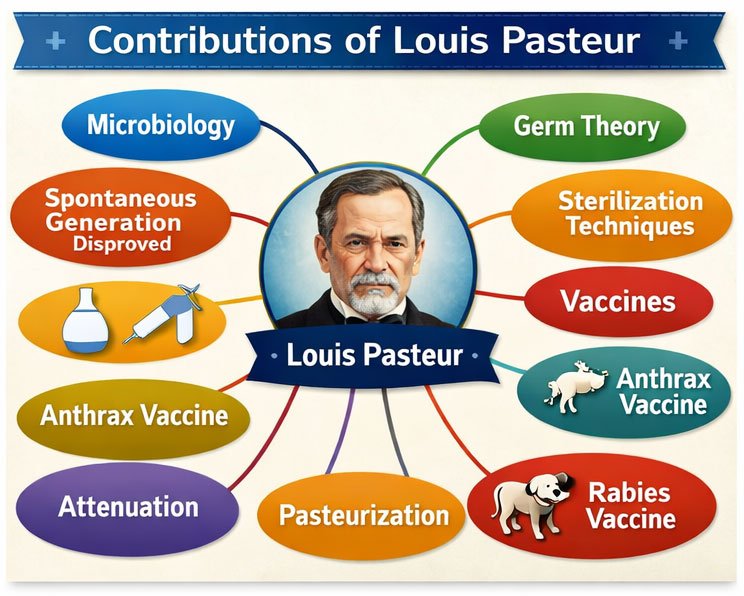
10. Anthrax Vaccine Development
Pasteur developed a live attenuated vaccine for anthrax. He weakened the bacteria using high temperature.
In a public experiment, vaccinated animals survived infection. In contrast, unvaccinated animals died.
Thus, this proved the effectiveness of vaccination.
11. Rabies Vaccine
Pasteur developed the rabies vaccine in 1885. This was a major breakthrough in medical science.
Although he did not know the exact cause, he successfully prevented the disease. Therefore, this became one of his greatest achievements.
12. Discovery of Pneumococci
Pasteur independently observed pneumococci in 1881. This discovery helped in understanding respiratory infections.
Importance of Louis Pasteur Contributions
Louis Pasteur contributions remain important even today. They:
- Established microbiology as a science
- Improved medical treatments
- Introduced safe laboratory practices
- Helped in vaccine development
In addition, his work continues to influence research and healthcare worldwide.
Conclusion
Louis Pasteur contributions laid the foundation of modern microbiology. His discoveries changed the way scientists understand diseases and microorganisms. Therefore, studying his work is essential for every student interested in biology and medical science.
<<< Back to Microbiology Notes Page
You may also like... NOTES QUESTION BANK COMPETITIVE EXAMS. PPTs UNIVERSITY EXAMS DIFFERENCE BETWEEN.. MCQs PLUS ONE BIOLOGY NEWS & JOBS MOCK TESTS PLUS TWO BIOLOGY PRACTICAL
Study Offline!! You can Download this Noteas as a PDF
🌿 Dear Readers,
I hope you found this article helpful and easy to understand. If you have any questions, suggestions, or thoughts, I would truly love to hear from you.
Please share your feedback in the comments below. Your participation helps make EasyBiologyClass a better learning space for everyone.
Best regards,
EasyBiologyClass