
ICBN Principles Explained for Botany Students
If you have ever wondered why plant names such as Mangifera indica or Rosa alba look universal and structured, the answer lies in ICBN Principles. The International Code of Botanical Nomenclature provides the rules that regulate plant naming worldwide. Therefore, understanding these principles is essential for every UG Botany student. Today, the Code is published as the International Code of Nomenclature for algae, fungi, and plants. However, the foundational ideas remain the same. You can easily download this note as a PDF using the link provided just below the post for quick access and offline reading.
Definition
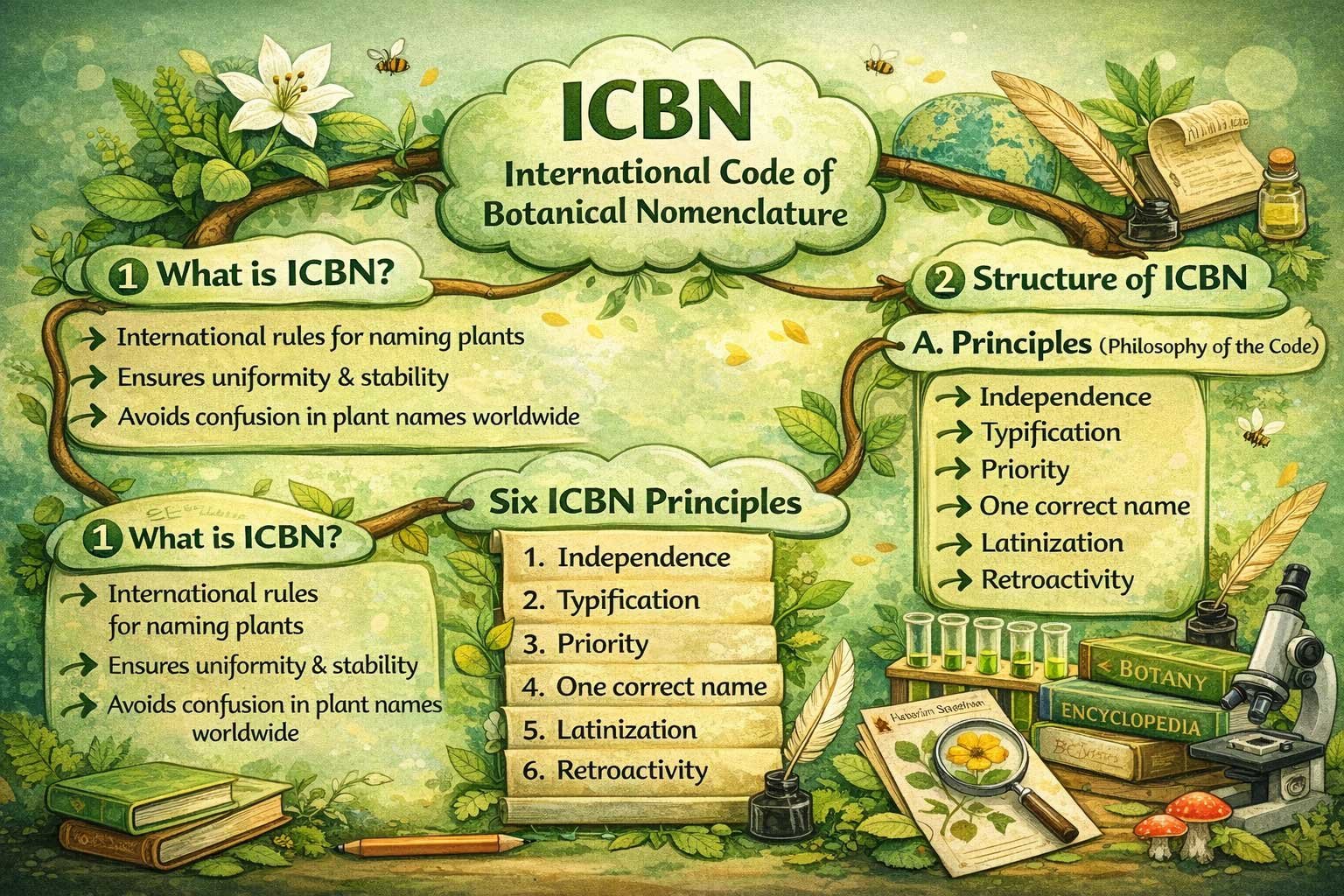
ICBN Principles are six fundamental guidelines that form the philosophical foundation of the International Code of Botanical Nomenclature. These principles ensure stability, uniformity, and clarity in naming plants, algae, fungi, and related organisms across the world.
Structure of ICBN and Its Components
The Code is organized into three main divisions.
1. Principles
These provide the theoretical base of botanical naming. They guide all decisions in taxonomy.
2. Rules and Recommendations
- Rules are mandatory. Names that violate them cannot be accepted.
- Recommendations are advisory. They promote uniformity but are not compulsory.
3. Provisions for Governance
These explain how the Code is interpreted and updated during International Botanical Congress meetings.
In addition, the Code contains appendices that list conserved names, rejected names, hybrid names, and suppressed publications.
How ICBN Functions Internationally
The functioning of the Code is systematic and democratic.
- Amendments are proposed during International Botanical Congress meetings.
- Experts discuss and vote on suggested changes.
- A revised edition of the Code is then published.
Each edition replaces the previous one. A plant name is changed only when new research justifies revision, the name violates rules, or priority demands correction. Thus, stability remains the primary goal.
ICBN Principles Explained with Examples
Principle 1 – Independence from Zoology
“Botanical Nomenclature is independent of Zoological Nomenclature. The Code applies equally to the names of taxonomic groups treated as plants whether or not these groups were originally so treated.”
Explanation: Plant naming rules are separate from animal naming rules. Even if an organism was previously classified differently, botanical rules apply if it is treated as a plant.
Example: Fungi follow botanical naming rules, not zoological ones.
Principle 2 – Typification
“The application of names of taxonomic groups is determined by means of nomenclatural types.”
Explanation: Each scientific name is permanently attached to a type specimen, usually preserved in a herbarium. Therefore, the type fixes the name.
Example: If confusion occurs about Rosa indica, taxonomists examine the original type specimen to confirm the correct application of the name.
Principle 3 – Priority of Publication
“Nomenclature of a taxonomic group is based upon priority of publication.”
Explanation: The earliest validly published name is accepted as the correct one. Later names become synonyms.
Example: If two scientists describe the same plant differently, the first valid publication has priority.
Principle 4 – One Correct Name Rule
“Each taxonomic group with a particular circumscription, position and rank can bear only one correct name, the earliest that is in accordance with the rules.”
Explanation: At any given rank, only one correct name is allowed.
Example: The sunflower family is correctly called Asteraceae, even though Compositae exists as a traditional name.
Principle 5 – Latinization of Scientific Names
“Scientific names of taxonomic groups are treated as Latin, regardless of derivation.”
Explanation: Scientific names are grammatically treated as Latin words, even if their origin is English, Sanskrit, or Chinese.
Example: Ginkgo and Vanda are treated as Latin names in scientific usage.
Principle 6 – Retroactivity of Rules
“The rules of nomenclature are retroactive, unless expressly limited.”
Explanation: The rules apply to previously published names unless the Code clearly restricts application.
Example: If an old name violates modern rules and no exception exists, it must be corrected.
Conclusion
In summary, ICBN Principles form the backbone of botanical nomenclature. They ensure stability, clarity, and global uniformity in plant naming. Understanding priority, typification, and the one correct name rule will strengthen your foundation in plant taxonomy.
MCQs on ICBN Principles
1. Which principle of ICBN ensures that the earliest validly published name is accepted?
Answer: C. Priority of publication
2. The scientific name of a plant is permanently attached to:
Answer: C. A nomenclatural type specimen
3. According to ICBN Principles, scientific names are treated as:
Answer: B. Latin words
4. Two botanists independently describe the same species in 1890 and 1895 using different names. Both publications are valid. According to ICBN Principles, which name is correct?
Answer: D. The name published in 1890
5. If an organism was originally described as an animal but is later treated as a plant, which nomenclature rules apply?
Answer: C. Botanical Code only
6. An old plant name published in 1820 violates a current rule of nomenclature. No exception is provided in the Code. What action should be taken?
Answer: C. Correct the name according to current rules
<<< Back to Plant Taxonomy/Systematics Notes Page
Study Offline!! Download this Note as a PDF
You may also like... NOTES QUESTION BANK COMPETITIVE EXAMS. PPTs UNIVERSITY EXAMS DIFFERENCE BETWEEN.. MCQs PLUS ONE BIOLOGY NEWS & JOBS MOCK TESTS PLUS TWO BIOLOGY PRACTICAL
🌿 Dear Readers,
I hope you found this article helpful and easy to understand. If you have any questions, suggestions, or thoughts, I would truly love to hear from you.
Please share your feedback in the comments below. Your participation helps make EasyBiologyClass a better learning space for everyone.
Best regards,
EasyBiologyClass