Germ Theory of Disease
The Germ Theory of Disease concept is a basic principle in biology and plant pathology. It explains that microorganisms cause many diseases in plants, animals, and humans. Therefore, understanding this theory helps botany students learn how plant diseases develop and spread. In addition, it provides a scientific base for disease control and prevention. You can easily download this note as a PDF using the link provided just below the post for quick access and offline reading.
What is Germ Theory of Disease?
Germ Theory of Disease explains that diseases are not random. Instead, they are caused by microorganisms such as bacteria, fungi, viruses, and protozoa.
Earlier, people believed diseases were caused by bad air or spontaneous generation. However, scientific experiments later proved these ideas wrong. Thus, the germ theory replaced old beliefs with evidence-based explanations.
Historical Development of Germ Theory of Disease
Key Contributors
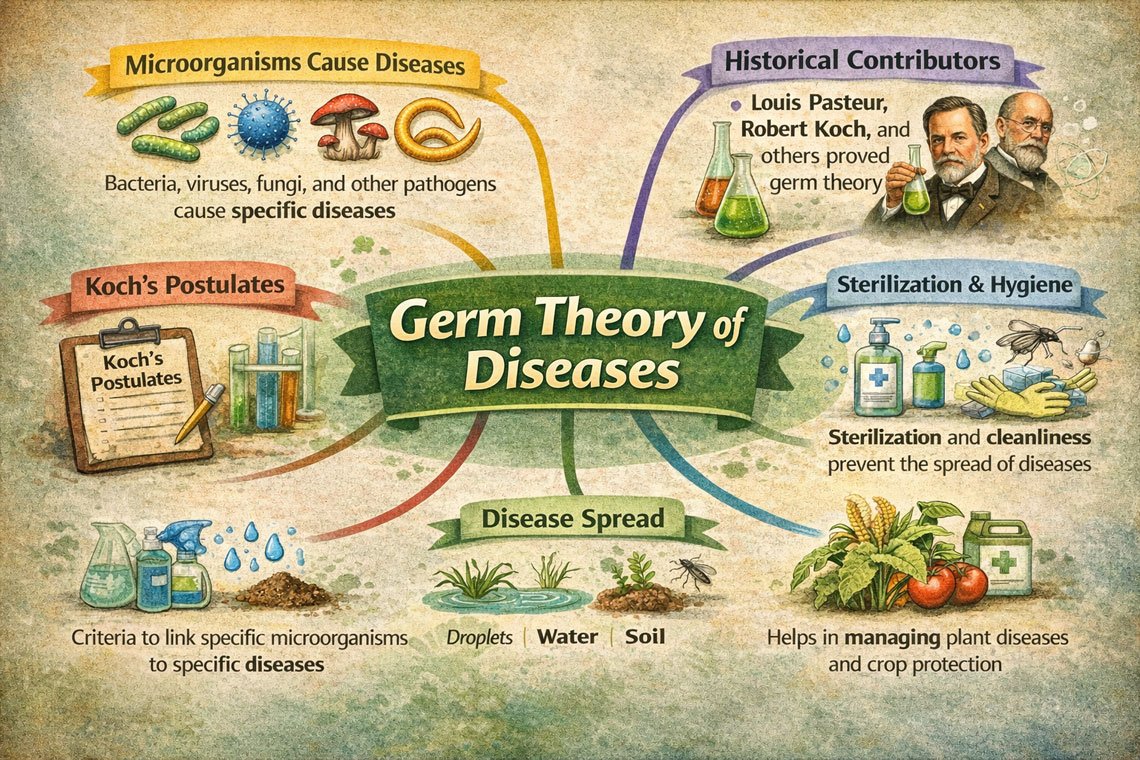
- Louis Pasteur proved that microorganisms cause fermentation and spoilage. Therefore, he rejected spontaneous generation.
- Robert Koch linked specific microbes to specific diseases using scientific methods.
- Other researchers improved sterilization and disease detection techniques.
As a result, these discoveries established modern microbiology and plant pathology.
Principles of Germ Theory of Disease
Main Principles
- Microorganisms exist in all environments.
- Only some microbes are harmful pathogens.
- Each disease is caused by a specific organism.
- Pathogens spread through air, water, soil, or vectors.
Therefore, these principles are essential for understanding plant disease cycles.
Germ Theory of Disease in Plant Pathology
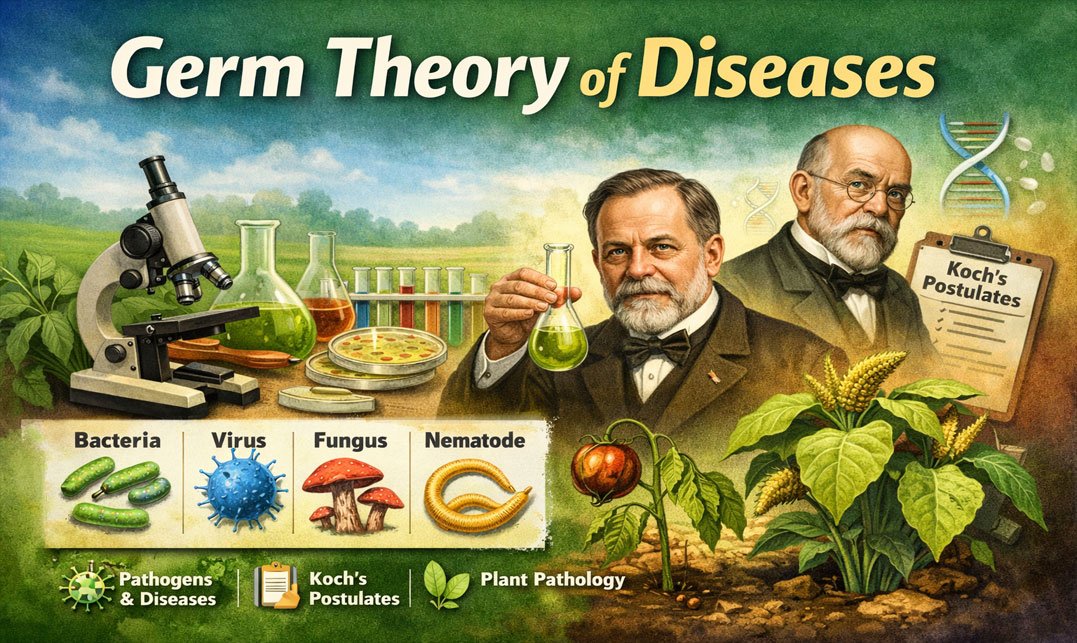
In plant pathology, Germ Theory Disease explains how pathogens infect plants. These pathogens include fungi, bacteria, viruses, and nematodes.
Examples of Plant Diseases
- Fungi cause rusts, smuts, and mildews.
- Bacteria cause wilts and leaf blights.
- Viruses cause mosaic patterns and stunted growth.
Thus, identifying the pathogen helps in selecting proper control methods.
Koch’s Postulates and Germ Theory of Disease
Koch’s postulates provide a scientific method to confirm disease causation. They support the Germ Theory Disease concept.
Main Steps
- The pathogen must be present in diseased hosts.
- It must be isolated and grown in pure culture.
- It should cause disease in a healthy host.
- The same pathogen must be re-isolated.
However, these rules have limitations, especially for viruses. Still, they remain important in disease diagnosis.
You may also like NOTES in... BOTANY BIOCHEMISTRY MOL. BIOLOGY ZOOLOGY MICROBIOLOGY BIOSTATISTICS ECOLOGY IMMUNOLOGY BIOTECHNOLOGY GENETICS EMBRYOLOGY PHYSIOLOGY EVOLUTION BIOPHYSICS BIOINFORMATICS
Applications in Agriculture
Major Applications
- Disease management: Helps choose correct chemicals or resistant varieties.
- Crop protection: Supports early detection of infections.
- Sanitation practices: Encourages removal of infected plants and tool sterilization.
Therefore, farmers can reduce crop loss and improve productivity.
Importance for Botany Students
- It builds a strong base in plant pathology.
- It helps in identifying disease-causing organisms.
- It supports advanced studies in microbiology and agriculture.
In addition, students can apply this knowledge in research and fieldwork.
Conclusion
The Germ Theory of Disease concept is a fundamental idea in biological sciences. It clearly explains how microorganisms cause diseases. Moreover, it helps in disease identification, prevention, and control. Therefore, botany students must understand this concept to improve plant health management and agricultural practices.
<<< Back to Microbiology Notes Page
You may also like... NOTES QUESTION BANK COMPETITIVE EXAMS. PPTs UNIVERSITY EXAMS DIFFERENCE BETWEEN.. MCQs PLUS ONE BIOLOGY NEWS & JOBS MOCK TESTS PLUS TWO BIOLOGY PRACTICAL
Study Offline!! Download this Notes as a PDF
🌿 Dear Readers,
I hope you found this article helpful and easy to understand. If you have any questions, suggestions, or thoughts, I would truly love to hear from you.
Please share your feedback in the comments below. Your participation helps make EasyBiologyClass a better learning space for everyone.
Best regards,
EasyBiologyClass