MCQ on CAM Cycle (Crassulacean Acid Metabolism)

The CAM (Crassulacean Acid Metabolism) cycle is a photosynthetic adaptation in some plants allowing them to fix CO₂ at night, storing it as malic acid. During the day, CO₂ is released for photosynthesis. This conserves water, making it ideal for arid environments. This is an MCQ on CAM Cycle with […]
Continue Reading
MCQ on C4 Cycle

MCQ on C4 Cycle (Hatch and Slack pathway)

The C4 cycle (Hatch and Slack Pathway) is a photosynthetic process in some plants where CO₂ is initially fixed into a four-carbon compound. This adaptation minimizes photorespiration and enhances efficiency by concentrating CO₂ around RuBisCO, enabling better performance under high light intensity, high temperatures, and low CO₂ conditions. This is […]

Continue Reading
MCQ on Photorespiration

MCQ on Photorespiration (C2 Cycle)

Photorespiration is a process in plants where the enzyme RuBisCO oxygenates RuBP, leading to the release of CO₂ instead of its fixation. This occurs when oxygen levels are high, reducing photosynthetic efficiency and wasting energy, particularly under stress conditions like high temperatures. This is an MCQ on Photorespiration (C2 Cycle) […]

Continue Reading
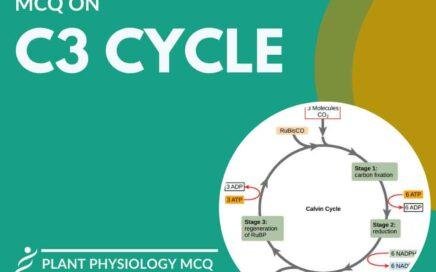
MCQ on C3 Cycle

MCQ on C3 Cycle (Calvin Cycle)

The Calvin cycle, also known as the C3 cycle, is a process in photosynthesis where carbon dioxide is converted into organic compounds like glucose. It consists of three phases: carbon fixation, reduction, and regeneration of ribulose-1,5-bisphosphate (RuBP). This is an MCQ on C3 Cycle of Photosynthesis. You may also like:  […]

Continue Reading
mcq on carbohydrates

MCQ on Carbohydrates Structure and Functions

Carbohydrates are organic compounds composed of carbon, hydrogen, and oxygen, typically in a 1:2:1 ratio. They serve as a primary source of energy for living organisms and include sugars, starches, and fibers found in foods like fruits, grains, and vegetables. This is an MCQ on Carbohydrates Structure and Functions. |  […]

Continue Reading