
Author Citation in Taxonomy
Author Citation in Taxonomy is an essential part of plant nomenclature. It ensures that every scientific name is complete and verifiable. Therefore, botanists always attach the name of the author who first validly published the taxon. This practice maintains accuracy and avoids confusion. Moreover, it helps students understand the historical origin of plant names. You can easily download this note as a PDF using the link provided just below the post for quick access and offline reading.
Taxonomy Notes | Taxonomy PPTs | Taxonomy MCQs
Definition
Author Citation in Taxonomy refers to the practice of adding the abbreviated name of the scientist who validly published a plant name. This citation confirms authenticity, ensures accuracy, and allows researchers to trace the original description of a species or taxon.
Understanding Author Citation in Taxonomy
Author citation forms an important rule under botanical nomenclature. Every validly published plant name must include the author’s name. However, the author’s name is usually abbreviated.
For example:
- Solanum nigrum L.
- L. stands for Carolus Linnaeus.
- Benth. for George Bentham
- Hook. for William Hooker
- Hook.f. for J. D. Hooker
- R.Br. for Robert Brown
- DC. for A. P. de Candolle
These abbreviations follow international standards. Therefore, consistency is maintained worldwide.
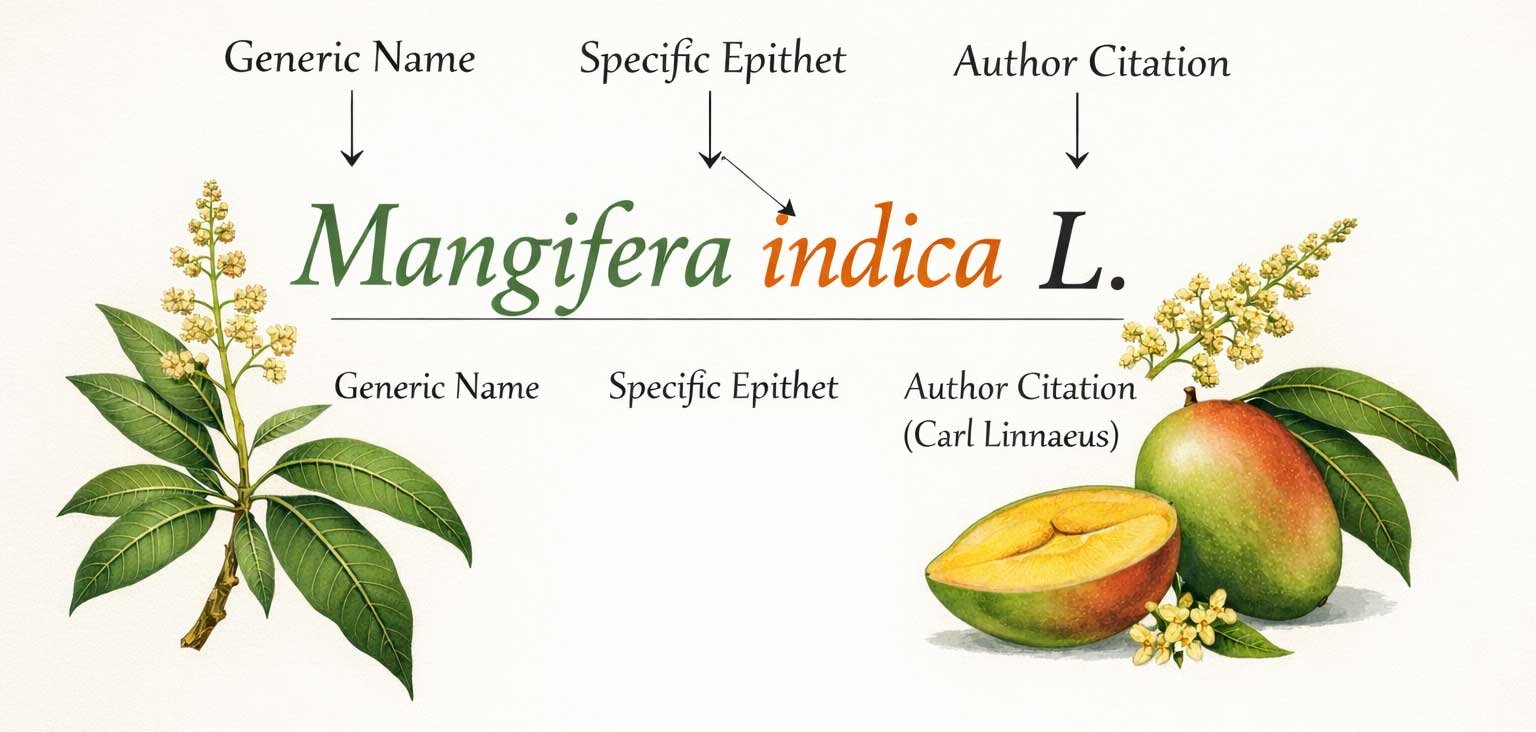
Single Author Citation
When only one scientist publishes a new species, the author’s name follows the scientific name.
Example:
- Solanum nigrum L.
Here, Linnaeus alone described the species. Thus, only one author is cited.
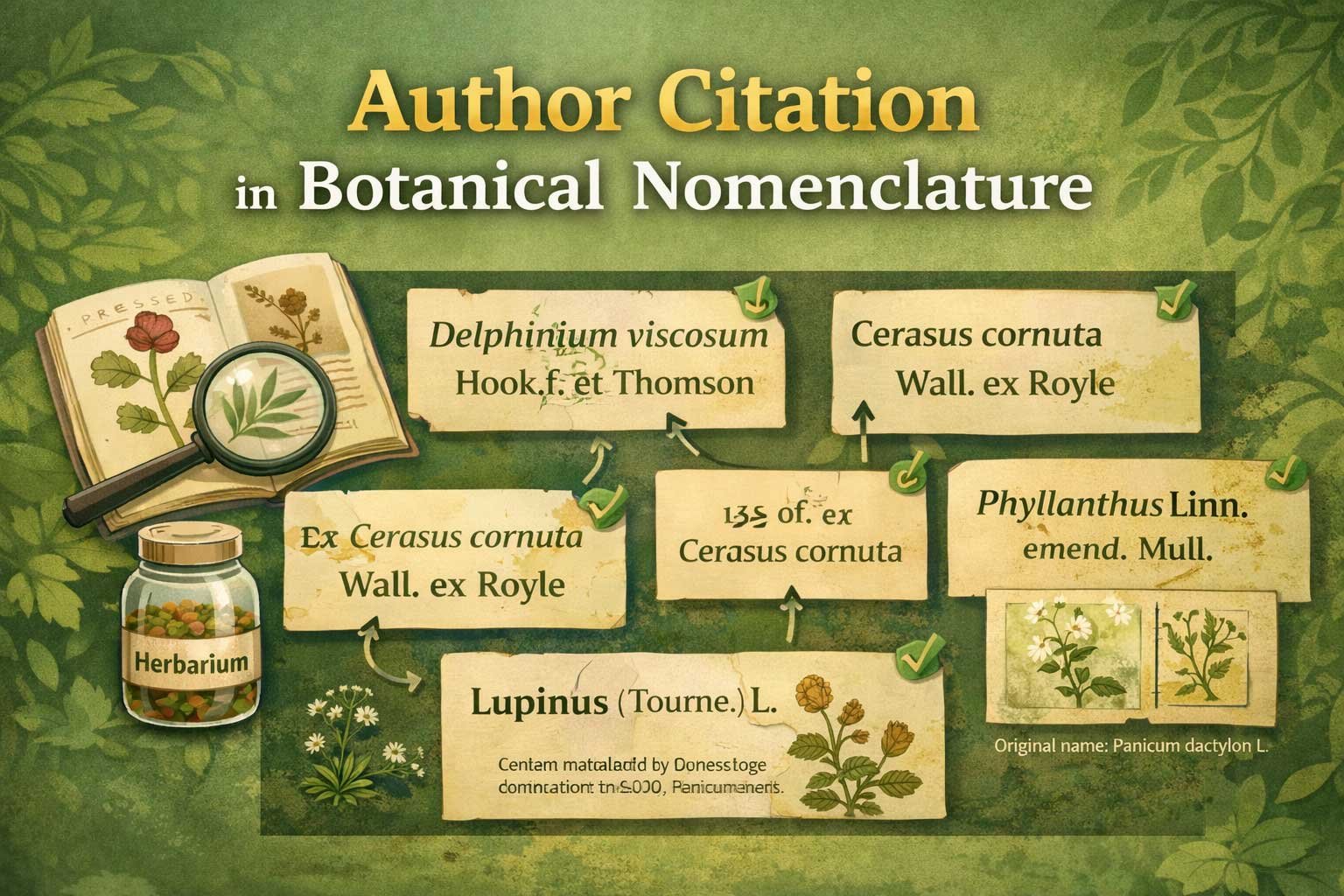
Multiple Authors in Author Citation in Taxonomy
Sometimes, more than one scientist is associated with a name. In such cases, different linking terms are used. Each has a specific meaning.
1. Use of “et”
The term et connects two or more authors who jointly publish a species.
Example:
- Delphinium viscosum Hook.f. et Thomson
Both authors contributed equally. Therefore, their names are linked by “et”.
2. Use of Parentheses
Parentheses indicate that a species has been transferred to another genus or its rank has changed.
The original name is called the basionym. The original author’s name is placed inside parentheses. The author who made the change is placed outside.
Example:
- Cynodon dactylon (L.) Pers.
Original name: Panicum dactylon L.
Here, Linnaeus first described the species. Later, Persoon transferred it to another genus. Thus, parentheses show the taxonomic change.
| You may also like NOTES in... | ||
|---|---|---|
| BOTANY | BIOCHEMISTRY | MOL. BIOLOGY |
| ZOOLOGY | MICROBIOLOGY | BIOSTATISTICS |
| ECOLOGY | IMMUNOLOGY | BIOTECHNOLOGY |
| GENETICS | EMBRYOLOGY | PHYSIOLOGY |
| EVOLUTION | BIOPHYSICS | BIOINFORMATICS |
3. Use of “ex”
The term ex is used when one author proposed a name, but another author validly published it.
Example:
- Cerasus cornuta Wall. ex Royle
Wallich proposed the name. However, Royle validly published it according to nomenclature rules. Therefore, “ex” indicates delayed validation.
4. Use of “in”
The word in is used when one author publishes a new species in the work of another author.
Example:
- Carex kashmirensis Clarke in Hook.f.
Clarke described the species. However, it was published in a book authored by Hooker. Thus, “in” clarifies publication details.
5. Use of “emend.”
The term emend. (emendavit) indicates correction or modification.
It is used when a second author changes the diagnosis or circumscription without altering the type.
Example:
- Phyllanthus L. emend. Mull.
Here, Muller modified the description but did not change the type. Therefore, the original author remains valid.
6. Use of Square Brackets
Square brackets indicate a pre-starting point author.
Botanical nomenclature officially begins from 1753 with Linnaeus’ Species Plantarum. If a name was published earlier, the earlier author is placed inside square brackets.
Example:
- Lupinus [Tourne.] L.
Tournefort published the name before 1753. However, Linnaeus validly adopted it later.
Author Citation in Infraspecific Taxa
When naming subspecies or varieties, author citation becomes more detailed.
Both the species and infraspecific epithets include authorities.
Example:
- Acacia nilotica (L.) Del. ssp. indica (Benth.) Brenan
L. is the original species author. Benth. described the subspecies. Brenan made the new combination. Thus, full citation ensures clarity.
Author Citation in Autonyms
An autonym automatically arises when a species is divided into subspecies for the first time.
In autonyms:
- The infraspecific epithet repeats the species name.
- No separate author is cited for the infraspecific epithet.
Example:
- Acacia nilotica (L.) Del. ssp. nilotica
Since it is based on the same type, no additional author is added.
Why Author Citation in Taxonomy is Important
Author Citation Botany ensures accuracy in scientific naming, historical traceability, international consistency, and proper application of nomenclature rules. Without correct citation, plant names may become confusing. Therefore, students must understand these conventions carefully.
Conclusion
Author Citation in Taxonomy plays a crucial role in plant nomenclature. It confirms the validity and history of scientific names. Moreover, it clarifies taxonomic changes such as transfers and revisions. Therefore, mastering author citation rules is essential for students preparing for exams and research in plant taxonomy.
<<< Back to Taxonomy Notes Page
| You may also like... | ||
|---|---|---|
| NOTES | QUESTION BANK | COMPETITIVE EXAMS. |
| PPTs | UNIVERSITY EXAMS | DIFFERENCE BETWEEN.. |
| MCQs | PLUS ONE BIOLOGY | NEWS & JOBS |
| MOCK TESTS | PLUS TWO BIOLOGY | PRACTICAL |
Study Offline!! Download this Note as a PDF
🌿 Dear Readers,
I hope you found this article helpful and easy to understand. If you have any questions, suggestions, or thoughts, I would truly love to hear from you.
Please share your feedback in the comments below. Your participation helps make EasyBiologyClass a better learning space for everyone.
Best regards,
EasyBiologyClass